
When someone searches “plumber near me” or “dentist Green Hills,” Google shows three businesses in the Map Pack. Those three occupy the most visible positions on the page. Everyone else is competing below them.
If you are not one of them, the cause is usually on a short list: an incomplete Google Business Profile, business information that disagrees with itself across directories, no system for getting reviews, and no content tying you to a specific part of Nashville. Which one applies to you is what an audit answers.
One thing on that list is not for sale. Google says local results are mainly based on relevance, distance, and prominence, working together. Distance is measured from the person searching, and no one can change it. Google does not publish how the three are weighed against each other, so we will not tell you that a stronger profile beats geography. What we will tell you, before you sign, is where distance looks like it is setting your ceiling. We work on relevance and prominence, because those are the two anyone can actually touch.
Inside that ceiling, the work is a system we call the Nashville Local Visibility System: six elements that cover what you can actually influence. Google Business Profile, NAP consistency and citations, reviews, local content, local links, and technical implementation.
The Six Elements of Nashville Local SEO
Google Business Profile Optimization
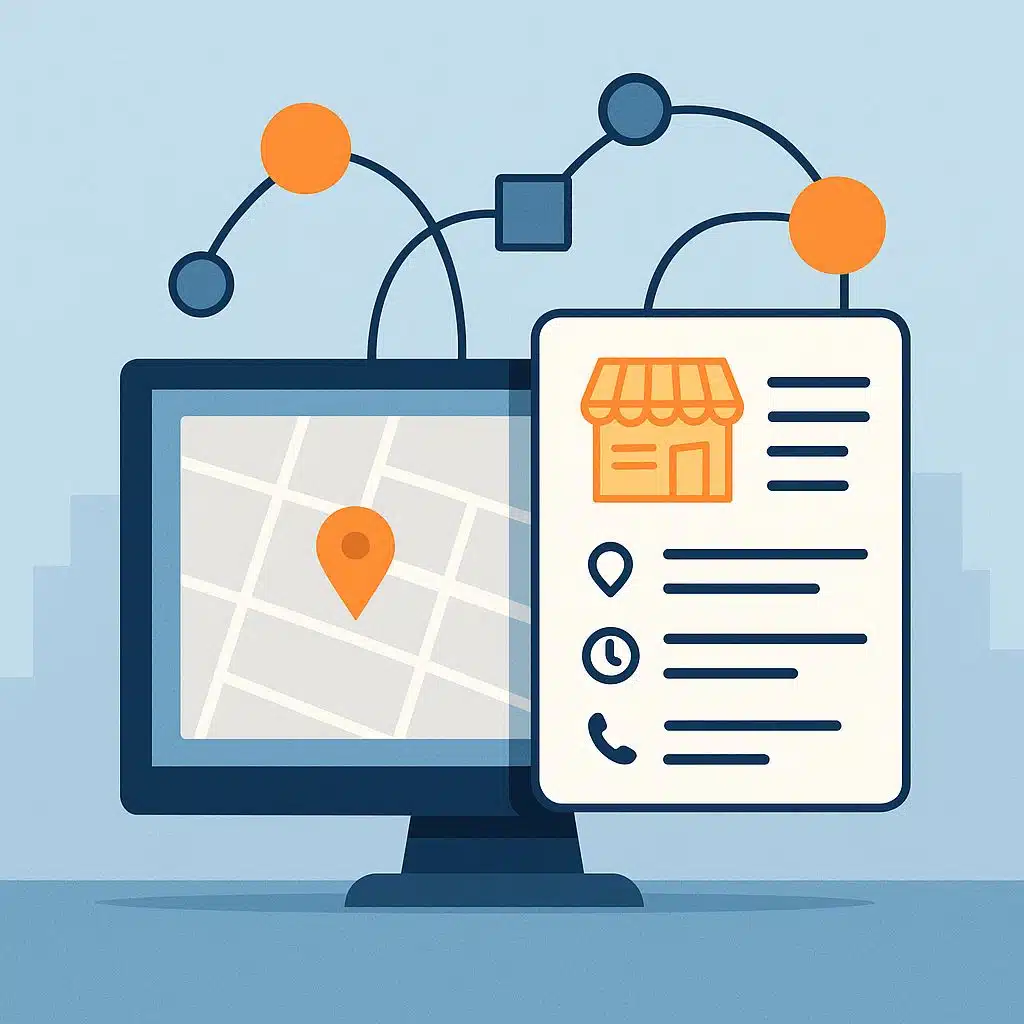
Review stars, hours, photos, click-to-call button, directions link. Most of what a searcher sees in the Map Pack comes from your profile. An incomplete profile usually looks worse to someone comparing three businesses side by side.
In the profiles we audit, the basics are usually there and the specifics are not: wrong primary category, no services listed, stock photos or none at all, no posts, empty attributes. Google ties relevance to complete and detailed business information, which means the whole profile rather than any single field. Category is the part of it most often wrong. The rest we treat as completeness and conversion work, because empty fields tell a searcher you aren’t paying attention — and that costs calls whether or not it costs rankings.
In our audits, the gap between top Map Pack performers and everyone else follows a pattern. Complete profiles with regular activity tend to hold their positions. Incomplete ones rotate in and out. We can see the pattern. We can’t see the cause inside Google, and we don’t claim to.
One risk worth naming before anyone touches anything: profile edits can trigger enforcement. Depending on the action, that can mean losing the ability to manage the profile, or the profile coming off Search and Maps until it is reinstated. In our experience the edits that most often trigger a review are category, address, and business name changes. We document the profile before we change it and sequence edits so a reinstatement, if it comes to that, has evidence behind it.
What we deliver:
- Complete optimization across the profile fields available for your category
- Category and attribute strategy
- Photo and video optimization with local relevance
- Google Posts and offers kept current
- Pre-change documentation and suspension risk review
NAP Consistency & Citations
Your business name, address, and phone number should match everywhere they appear. Google describes prominence as drawing on information about your business from across the web. When that information disagrees with itself, you are asking both a search engine and a customer to guess which version is real.
Nashville businesses commonly have NAP problems they don’t know about. Old phone number on Yelp. Suite number missing on Facebook. Business name variation on industry directories. Each mismatch is one more version of you in circulation.
One trap here: dynamic call tracking numbers break NAP consistency when they replace your main number in directories and on your site. We use tracking that leaves your primary number intact.
Citations put consistent information where people and search engines look. Beyond Yelp, Apple Maps, and Bing, Nashville businesses benefit from local citations where relevant and eligible: business associations, local publications, neighborhood-specific directories.
What we deliver:
- NAP audit across major directories, map platforms, and key data sources
- Inconsistency correction and duplicate removal
- Citation building on directories that are actually used
- Nashville-specific local citation development
- Ongoing monitoring for new inconsistencies
Review Strategy & Reputation Management
Google is specific about this one: more reviews and positive ratings can help your local ranking. That is the whole of what Google says. Review velocity and recency are practitioner assumptions — widely held, not confirmed by Google — and we don’t price them as facts.
What isn’t in question is what reviews do to a person looking at three businesses side by side.
Most businesses wait for reviews instead of asking. They arrive slowly and skew toward customers motivated to complain. A system fixes the timing, not the outcome: every customer gets the same request at the same point in the job, and the review they leave is theirs to write.
That last part is a policy line, not a preference. Google prohibits selectively soliciting positive reviews, discouraging negative ones, and asking that specific content be included in a review. As of April 2026 it also prohibits review quotas for staff. We build request systems that stay inside those rules, because the alternative puts your reviews and your profile at risk.
What we deliver:
- Review request system covering every customer, not a filtered subset
- QR codes, email sequences, SMS follow-ups
- Response process for reviews after they post, positive and negative
- Policy review of any existing request flow you’re running
- Competitor review analysis
Local Content Optimization
Generic content that could describe any city gives a searcher, and a search engine, nothing to attach to Nashville. Competitors with Nashville-specific content have an advantage you handed them.
You don’t have one Map Pack position. You have a different one for every point on the map, because distance is measured from whoever is searching. A business dominating Germantown might be invisible in Donelson, and that is geometry before it is strategy.
Two kinds of business read this differently. If customers come to you, your address is public and anchors the profile. If you go to them, Google asks you to remove the address and set a service area instead, which shows customers where you work and helps them find you. What it does not do is switch off distance. The searcher’s location still counts, whether or not your address is showing.
Local content means more than adding “Nashville” to your title tags. It means referencing the neighborhoods your customers live in. Green Hills and Brentwood have different demographics and different competitors. A plumber serving 37205 faces different competition than one serving 37206. Content that acknowledges those differences reads like a business that knows this market.
Service businesses often need location pages, and this is where the work goes wrong most often. Google’s spam policies name pages targeted at specific cities or regions that funnel users to one page. A set of pages that swap the city name and change nothing else is that pattern. A location page earns its place when it carries something only that area has: work you have actually done there, people who will vouch for it, specifics of serving it. If we can’t write that page honestly, we tell you it shouldn’t exist. For businesses with several real locations, the coordination problem is its own project — see our guide to .
What we deliver:
- Local content audit and gap analysis
- Service area pages where the material justifies one
- Nashville-specific content optimization
- Neighborhood pages with something only that neighborhood has
- Local blog content strategy
Local Link Building
Nashville Scene mentions your business. Nashville Area Chamber links to your site. A Germantown neighborhood blog features your services.
This is the one element Google is explicit about: prominence includes how many websites link to your business. We read that as a reason to pursue links a person in Nashville would recognize, rather than directory volume. Local publications, business associations, neighborhood organizations, event sponsorships.
Most of the sites we audit have no local link strategy at all. They wait for links, which means links rarely arrive. Meanwhile competitors sponsor events, partner with complementary businesses, and give local press something to write about. The full method, including what we won’t do and how paid relationships get handled, is in our guide on .
What we deliver:
- Local link opportunity identification
- Nashville media and blog outreach
- Local partnership and sponsorship strategy
- Chamber of commerce and association links
- Competitor backlink gap analysis
Technical Local SEO
Schema markup describes your business to search engines: what you are, where you are, what you offer. Structured data can make a page eligible for certain result types. It is not a general ranking factor, and we don’t sell it as one.
Most sites already emit some schema automatically through an SEO plugin, and it is usually incomplete, duplicated, or contradicting itself. The work is more often correcting what’s there than adding from zero.
Technical local SEO also means mobile performance, location page structure, and correct Google Maps embeds. These belong to the website side of local visibility: what a visitor meets after the click, and how clearly your pages describe where you work. We do not treat them as Map Pack levers and Google does not name them as such. Where the problems run deeper than local — crawlability, Core Web Vitals, site architecture — that’s a separate engagement, covered on our page.
What we deliver:
- LocalBusiness schema implementation
- Schema audit for conflicts, duplicates, and invalid markup
- The schema types your pages are actually eligible for
- Google Maps embed optimization
- Mobile performance optimization
- Location page technical structure
Our Process
Step 1: Local SEO Audit
We analyze your current local visibility. GBP completeness, NAP consistency across directories, review profile, local content signals, citation presence, and technical implementation. Everything that affects whether you show up when Nashville customers search.
What you get: Prioritized audit report showing where you stand, what’s broken, and what competitors do better.
Timeline: 5-7 business days
Step 2: Foundation Building
We fix what’s broken and fill what’s missing. GBP optimization, NAP corrections, schema implementation, and baseline citations. This foundation has to be solid before anything built on top of it holds.
What you get: Fully optimized GBP, corrected citations, implemented schema, and documented changes.
Timeline: 2-3 weeks
Step 3: Growth Execution
With foundations set, we build momentum. Review request systems, local content development, service area pages, and local link outreach.
What you get: Monthly deliverables based on your specific growth priorities. Content, links, reviews, or expanded geographic targeting.
Timeline: Ongoing
Step 4: Tracking & Optimization
Because distance is measured from the searcher, a single ranking number is meaningless. We track Map Pack positions across a grid of Nashville ZIP codes and neighborhoods, which shows where you surface and where you don’t.
What you get: Monthly reports showing Map Pack positions by location, review growth, GBP insights, and traffic from local searches.
Timeline: Ongoing
Who This Isn’t For
Not every Nashville business needs local SEO. Some shouldn’t invest in it at all.
If you serve customers nationwide or online-only: Local SEO won’t help. You need organic SEO built on content and links, not Map Pack positions. For online retail that’s ; for software companies it’s .
If you’re not ready to respond to leads: More visibility means more calls. If you can’t answer the phone or follow up within hours, you’ll waste the traffic we generate.
If you expect results in 30 days: We can move fast, but competitive Map Pack positions take sustained work. If you need immediate leads, start with Google Ads while we build your local foundation.
If your service quality can’t support reviews: We can build the request system, but we can’t decide what customers write. If people aren’t happy enough to say so, local SEO will expose that, not solve it.
If distance is the whole problem: If the searches you want are happening well outside the area you actually operate in, and you have no location there, you are asking optimization to work against geometry. We would rather tell you that than take the budget.
We turn away businesses that aren’t ready. It’s better for both of us.
What We Find in Nashville Local SEO Audits
Same patterns, different businesses:
- GBP with wrong categories, missing services, no photos
- Business name/address/phone mismatched across directories
- No review system, relying on passive feedback
- Service pages with zero Nashville-specific content
- Schema that’s missing, duplicated, or contradicting itself
- “Location pages” that swap city names and nothing else
- Review request flows that filter out unhappy customers, which is a policy violation waiting to be reported
In the audits we run, these are not edge cases. They are the baseline.
Spam Competitors Are Gaming Your Market
Keyword-stuffed business names. Fake listings at residential addresses. Category abuse to show up in searches they don’t belong in. Local search is full of competitors cheating, and Google doesn’t always catch it.
We include spam audits in our work. We document evidence — screenshots, categories, address patterns — and submit redressal requests through the appropriate Google channels. This isn’t guaranteed to work, and Google moves slowly. But if a fake listing is outranking you, we’d rather contest it than pretend it isn’t there.
Where Nashville Local SEO Engagements Break
These are failure modes, not accusations about who you hired. Each one is visible in an audit.
Bulk citations without QA. Cheap citation packages push your information out to low-quality directories without checking what is already listed. You end up with more versions of your NAP in circulation than you started with. We regularly inherit these cleanups.
Templated localization. The same page structure and copy that was built for another city, with the city name swapped. No Nashville citations, no local relationships, no sense of which neighborhoods carry the searches. It reads generic because it is.
Fragmented ownership. When the profile, the website, the reviews, and the ads sit with four different people, nobody owns the contradictions between them. Hours change in one place and not the other. A call tracking number replaces the main number on the site but not in the directories.
Set-and-forget maintenance. A profile is not a one-time project. Google changes profile features. Competitors keep asking for reviews. Directory data goes stale. Work that stopped a year ago is not work that is still holding.
We focus on Nashville local SEO. No generic playbooks, no junior staff learning on your account.
Local SEO by Industry
Legal Services: Practice area visibility often depends on neighborhood-level targeting. “Divorce attorney Nashville” is different from “custody lawyer Brentwood.” Davidson County searches behave differently than surrounding counties, and “near me” legal queries show distinct Map Pack patterns. We build GBP categories around practice areas, create location pages for courts you serve where there is real material for one, and develop review approaches that stay inside Tennessee bar advertising rules.
Home Services: Plumbers, HVAC, electricians live and die by the Map Pack. When someone’s AC breaks in July, the businesses visible at that moment have the advantage. Emergency queries spike hard, and service radius is the constraint — a plumber in Bellevue showing for East Nashville searches is a mismatch geometry won’t reward. We optimize for “near me” and emergency queries, build service area pages where the work justifies one, and set up review systems that keep running.
Healthcare: Multiple provider profiles, HIPAA constraints on how reviews are handled and responded to, insurance and specialty targeting. Individual practitioner profiles often compete with the practice’s main listing. We manage multi-practitioner GBP presence, optimize for condition-specific searches, and build content that demonstrates expertise without compliance risk.
Restaurants & Retail: Foot traffic starts with “near me” searches. Menu URLs, reservation links, accurate hours, and current photos are what a searcher compares when three options sit side by side. We optimize for category searches, keep review requests running, and make sure the profile reflects what you are actually serving today.
Nashville Local SEO FAQ
How long until I show up in the Map Pack?
Google publishes no timeline for this and we will not invent one. In the engagements we have run, profile corrections tend to register first and position stability comes later, with competitive categories like HVAC, personal injury, and home services taking longest. What decides it is competition density, your starting point, your distance from where the searches actually happen, and how much gets built. We report against your queries rather than against the contract date.
Do you guarantee Map Pack rankings?
No. Anyone guaranteeing specific rankings is lying. Google weighs many factors and some — distance being the plainest — are outside anyone’s control. What we commit to is doing the work Google actually names, tracking results transparently, and telling you what we cannot move.
What’s the difference between local SEO and regular SEO?
Local SEO focuses on Map Pack visibility and location-based searches: profile optimization, citations, reviews, geographic relevance. Organic SEO focuses on rankings through content, links, and technical work. Many businesses need both. In the engagements we have run, local work tends to show up in the phone log earlier, though that depends on the category and on what visibility already exists.
How important are reviews for local rankings?
Google says more reviews and positive ratings can help your local ranking, and lists reviews as part of prominence. Beyond that statement, the specifics — how much recency matters, whether velocity is weighted — are practitioner belief rather than documented fact, and we will tell you which is which. What is not ambiguous is the effect on a person choosing between three businesses.
What if I have multiple locations?
Each location needs its own profile, unique content, and location-specific optimization. We build systems that scale across locations while keeping each one distinct. No duplicate content, no thin pages swapping city names.
Can I do local SEO myself?
Some of it. You can claim and optimize your profile, ask customers for reviews, and fix obvious NAP inconsistencies. Comprehensive citation audits, schema correction, local link building, and grid-based rank tracking take tools and time most businesses do not have in-house.
What happens if my profile gets suspended?
It depends on the enforcement action. Some restrict your ability to manage the profile while it stays visible; others take it off Search and Maps until it is reinstated. Reinstatement is an evidence process: proof of address, signage, licensing, whatever applies. In our experience these follow a category, name, or address change more often than anything else, which is why we document a profile before editing it.
What Changes in the First 30 Days
Not promises. Sequencing.
Week 1: Profile audit and fixes. Category strategy. Spam, duplicate, and suspension risk checks. Competitor snapshot.
Week 2: NAP cleanup across priority directories. Core citation submissions. Review request system built and policy-checked.
Week 3: Posts live. Review requests going to every customer. Service area page planning.
Week 4: Local content priorities identified. Link target list built. Grid-based rank tracking baseline established.
By day 30 the work on our side is done: profile corrected, citation corrections submitted, review system built and policy-checked, roadmap set for months 2-6. Directories and Google process changes on their own schedule, so some corrections land after the month does. Growth work begins either way.
Get Your Free Local SEO Audit
Each audit takes three to four hours of actual analysis — no templates, no automated reports, no junior staff. We take on eight a month alongside client work, which is the real constraint.
What you will see in your audit:
- GBP category mismatch report
- Duplicate and spam risk scan
- NAP inconsistency count across top directories
- Review profile benchmarked against your top three competitors
- Policy check of the review request flow you are running now
- Neighborhood grid snapshot showing where you rank and where you do not
If we cannot identify a clear path to top three visibility in the neighborhoods that matter, we will tell you not to spend the money.
The businesses in those three spots are not automatically better than you. Some are closer to the person searching. Some have been established longer, or carry more reviews and more references across the web. Some simply did the work. The audit tells you which of those you are actually up against.
Or call Rank Nashville:
Related Services
- — crawlability, speed, and schema when the problems run deeper than local
- — content and page-level optimization that supports local rankings
- — our diagnostic order when visibility drops
- — the full link program, including what we will not do
- — what Google has actually said, and what it has not
Further Reading
- — Google’s explanation of relevance, distance, and prominence
- — official documentation on profile features and requirements
- — what is and is not allowed when asking for reviews
- — technical reference for structured data markup