
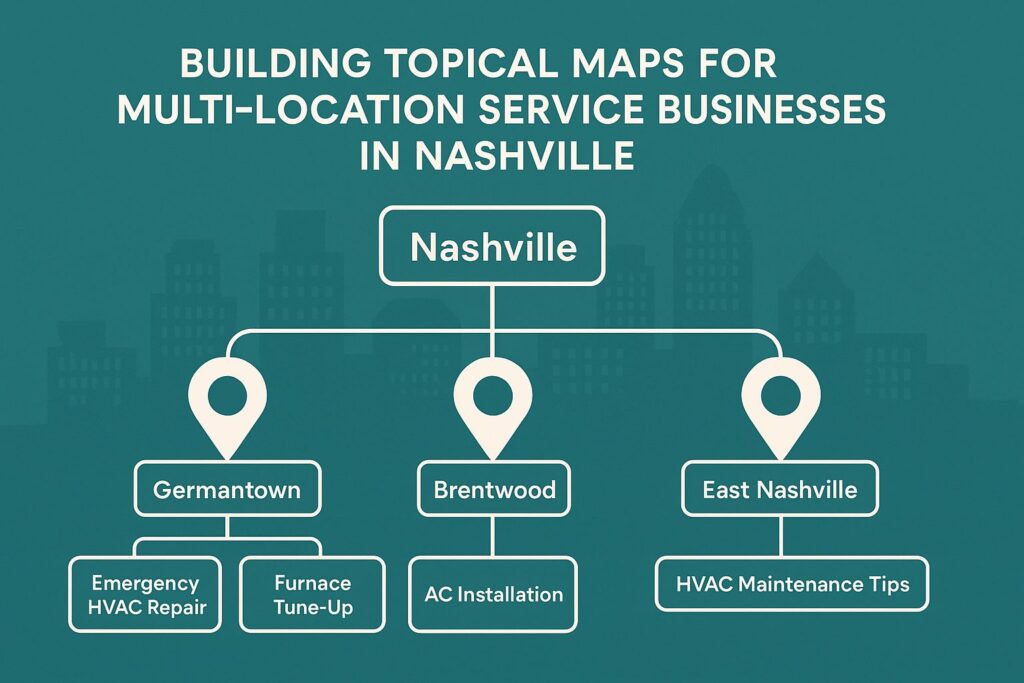
Most Nashville service businesses start with one location and one set of keywords. SEO works. Calls come in. Then the second location opens. Maybe a third. And something breaks.
At Rank Nashville, we see this pattern every month. A multi-location HVAC company wonders why Brentwood ranks but Antioch is invisible. A dental group watches one location dominate while four sit on page three. Multiple URLs trade places for the same query. Landing-page selection turns unstable, and the office that should be answering a search is not the one appearing for it.
The individual pages may have problems of their own, but on a multi-location site the larger failure is often structural: nobody decided which page should own which service, location, intent, and conversion path before the pages were built.
That decision set is what a topical map is. This page explains what we audit before making it, what the map works through, how we decide to build, consolidate, redirect, or refuse a page, and what we measure afterward.
Why Multi-Location Changes the Problem
Single-location SEO follows a straightforward path. One Google Business Profile, one set of service pages, one body of content targeting one geographic area. The signals are clean.
Multi-location changes the equation. A plumbing company with offices in Germantown and Bellevue now has two service pages for drain repair, two location pages making similar claims, and two GBP listings. Without a deliberate plan connecting these locations to distinct neighborhoods, similar service-location pages can produce overlapping query footprints, unstable landing-page selection, and weak differentiation. We inspect the actual query, URL, internal-link, canonical, and conversion data before deciding whether pages should be consolidated, redirected, rewritten, or preserved.
The instinct most businesses follow — duplicating what worked at location one and swapping the city name — is where this starts. Location pages that change only the place name may add too little independent value and can fit Google’s doorway-abuse pattern when they target substantially similar searches and funnel users toward the same destination. We test whether separate pages serve a distinct user and business need before creating them.
Even businesses that avoid outright duplication often build deep content for their flagship location and leave the rest thin, creating an uneven profile across the site.
Nashville makes this harder. A business serving both Green Hills and East Nashville is not just serving two ZIP codes. These neighborhoods have different demographics, different competitors, different seasonal patterns, and different search behaviors. The plan has to reflect those differences, not paper over them.
Industry surveys such as Whitespark’s Local Search Ranking Factors provide context on the perceived importance of on-page relevance and local signals. They do not establish topical maps as a separately weighted local-pack ranking factor. We use the map as a planning and architecture system, then measure whether the resulting pages improve visibility, landing-page selection, and qualified inquiries.
What We Audit Before Adding Location Pages
No page decision is made before the current state is known. What we look at:
Existing URL inventory. Every live URL, its intended role, indexability and canonical state, and, where sufficient data exists, its query footprint, impressions, clicks, and selected landing-page behavior.
Query overlap map. Where two or more URLs repeatedly surface for the same primary intent, and whether that overlap is benign or contested.
Canonical and internal-link state. What the site currently tells Google about which page is the authoritative one for a given service-location pair, and whether the internal link graph agrees.
Physical-location structure. Which addresses are real, staffed, and distinct; which GBP listings exist; where service areas genuinely overlap and where the overlap is only in the copy.
Conversion path per location. Which forms and phone numbers route where, and whether a search that reaches page A results in an inquiry to location A.
Demand evidence. Location-modified Search Console queries, call tracking, intake records, and grid-based rank tracking for the business’s own footprint — not category averages.
Competitor set by query and grid point. Which businesses appear for the agreed query set across sampled locations in each priority area, and what pages and local assets support that visibility.
The audit output is a state-of-play, not a page list. The page list comes next.
What the Topical Map Is
The map is a decision document, not a content calendar. Its purpose is that page-level decisions are made once, in writing, with reasons attached — so that whoever executes them, including a developer or writer who was not in the room, is working from stated intent rather than guesswork. What it works through:
A service-by-location grid. Services along one axis, neighborhoods and ZIP codes along the other. Every intersection carries a decision, not a placeholder.
A per-cell verdict: build, consolidate, redirect, rewrite, or leave alone. Each verdict is annotated with the reason — demand evidence, existing performance, physical distinction, or absence of any of these.
Primary page ownership. For every service-location-intent combination, the single URL responsible for it. This is the field that resolves cannibalization arguments later.
A per-page role definition. Every commercial service or location page receives a primary service, location, intent, and conversion role. Supporting content receives a primary topic, search intent, audience question, and the commercial or location pages it is responsible for supporting. A page that cannot be assigned a defensible role in either group does not get built.
An internal-link plan. Which pages link to which, in which direction, with what anchor intent. Service hubs down to neighborhood pages, neighborhood pages laterally to related local services, supporting content up to what it supports.
A claims register. Every local claim in the plan that requires your confirmation before publication — served neighborhoods, response times, staffing, credentials, results. We do not publish a local claim you have not approved.
A measurement baseline. The pre-implementation state of the metrics we will judge the work against.
Scope, format, and which of these are included in a given engagement are set in the engagement itself.
When We Build, Consolidate, Redirect, or Refuse a Page
A dedicated page is justified when the distinction is real and supportable across several conditions at once:
- A separate physical location or a genuinely separate service area
- A different service or a materially different intent
- Local proof that exists — not proof we would have to invent
- Demonstrated search demand in that business’s own data
- A conversion path that differs from the alternative page’s
- Independent value to the user, stated in a sentence a reader would agree with
We consolidate when two candidate pages fail to differ on those conditions. Five near-identical “teeth whitening” pages across five locations give the site no advantage over one strong page plus honest location context.
We redirect when an existing URL has authority but no distinct job left.
We refuse when the only argument for a page is that the grid has an empty cell. We do not create a URL merely to fill every cell in the grid.
A single service page may be sufficient when the service, intent, proof, and conversion path do not materially change by location. Dedicated location pages are added only where the distinction is real and supportable.
On overlap: each page receives a primary service, location, intent, and conversion role. Some query overlap is normal — multiple URLs taking impressions for the same query is not automatically a defect. We intervene when multiple URLs repeatedly compete for the same primary intent without giving the user or the business a clear reason for both pages to exist.
How We Assign Services and Locations Without Inventing Demand
We combine location-modified Search Console queries with call tracking, intake records, customer data, and grid-based rank tracking. Search Console tells us what users typed, not the ZIP code they searched from. ZIP-level visibility comes from defined query sets measured across specific grid points.
Some observations about this market recur across our work. These are recurring patterns we have observed across our Nashville campaign work, not universal neighborhood rules. Their usefulness depends on the industry, service, time period, and data available for the specific business. We test each pattern against Search Console, call tracking, intake records, grid visibility, and current competitor results before using it to assign pages.
In some of our service-business datasets, Brentwood and Franklin (37027, 37064, 37067) have produced more comparison and research-stage queries — brand comparisons, warranty questions, service tiers ahead of pricing. East Nashville (37206, 37216) has shown more urgent service language, with “near me” and same-day modifiers appearing more often. In parts of Antioch and Southeast Nashville (37013, 37217) we have seen higher query counts alongside longer paths to inquiry, and thinner competitor content depth. Germantown and the Nations (37208, 37209) have shown query growth in datasets where established competitors had not yet published much local depth.
We do not assume those patterns transfer to another business or industry without confirming them in its own data. HVAC, dental, legal, and general service businesses do not share one demand model, and a pattern from one is a hypothesis for the next — not a finding.
What survives that test shapes the assignment. When we built a topical map for a Nashville HVAC company, the grid separated the locations sharply: installation searches clustered in Brentwood (37027), while emergency-repair demand concentrated in East Nashville (37206). The client data justified separate priorities; it did not make that pattern a rule for other HVAC companies or establish a single market-wide cause.
Every supported priority is either assigned to a page or deliberately consolidated. We do not create a URL merely to fill every cell in the grid.
What Implementation Includes
The map can be executed by your team or by ours. Where we implement, the work is:
Page builds and rewrites to the role definitions in the map — each page written for its assigned service, location, intent, and conversion role, with local specifics supported by that market’s search, intake, and customer data. A Brentwood cosmetic dentistry page connects to porcelain veneers, elective-procedure coverage, and recovery expectations. An East Nashville page for the same practice connects to emergency care, payment plans, and walk-in availability. Same practice, same category, different pages because the patients differ.
Consolidations and redirects from the decision table, with the internal links and canonicals updated to match.
Internal-link execution to the plan, so the link graph and the ownership table agree.
Claims approval loop. Nothing local goes live without your sign-off from the claims register.
Whether implementation is included, and in what sequence, is set in the engagement.
What We Measure After Launch
After implementation, we measure whether landing-page selection, location-level visibility, and qualified inquiries improve. We do not reduce every change to Google “understanding” the site better when several mechanisms may be involved.
Against the baseline captured in the map:
- Landing-page selection stability — is the intended URL now the one Google selects for its assigned queries?
- Location-level visibility — grid and query visibility by ZIP, per location, not site-wide averages.
- Query footprint separation — has contested overlap between the flagged URLs decreased?
- Qualified inquiries by location — form submissions and calls routed to the correct office, judged against intake records rather than raw form counts.
Rank Nashville’s general published range is that measurable search movement may begin within 60 to 90 days, while stronger results can take four to six months depending on competition, starting condition, and scope. Those figures are not a topical-map, multi-location, or neighborhood-specific benchmark, and no ranking timeline is guaranteed.
Keeping the Map Current
Review frequency depends on expansion pace, publishing activity, search volatility, and competitive change. Quarterly review may make sense for an actively expanding business; a stable operation may need a lighter schedule. Triggers that warrant a review regardless of calendar: a new location, a new service line, a migration or redesign, a competitor’s visible content push, or a location whose performance drops without an obvious cause.
An existing architecture can reduce duplicated planning when a new location opens. The actual time and cost still depend on the services, market, proof, content, profile, and technical work that location requires. A new location that brings a new service area, a new GBP, a new competitor set, a separate conversion flow, or a new compliance requirement can cost more than the last one did, not less.
Nick Rizkalla, who leads our strategy with over 14 years of experience across medical, legal, and service business clients, frames the map the same way: it is not a content calendar but a blueprint for assigning every location and page a defensible role. When five locations keep competing for the same queries and landing pages, his read is that the problem is structural rather than a matter of content volume.
Frequently Asked Questions
How is a topical map different from a list of keywords? A keyword list tells you what people search for. A topical map tells you which pages to build, which to consolidate, which to redirect, which URL owns which intent, and how they link. It is a decision set for your site, not a list of targets.
How many pages will we need? We do not estimate page count by multiplying locations by services. The map is scoped after we review the existing URLs, verified demand, location differences, overlap, and consolidation opportunities.
Can we build a topical map ourselves? The concept is learnable. The harder parts are the audit inputs — reading your own query, canonical, and intake data honestly — and the discipline to refuse a page when the grid cell has no case. The two failure modes we check for are too many thin pages and too few pages trying to carry several distinct jobs.
How long until we see results? See the measurement section above. Rank Nashville’s general published range is 60 to 90 days for measurable movement and four to six months for stronger results, depending on competition, starting condition, and scope. That range is not specific to topical maps, multi-location work, or any particular neighborhood, and no timeline is guaranteed.
What if our locations serve overlapping areas? Common, and the map addresses it directly. Each page gets primary ownership of a service-location-intent combination. Overlap in service area does not require overlap in page ownership.
Does this replace our existing content? Often not. The audit regularly finds that existing pages can be consolidated, repointed, or rewritten rather than replaced. Pages with authority and no distinct job get redirected rather than deleted.
Central or local content ownership? Fully centralized production can become generic, while fully decentralized production can become inconsistent. We usually set strategy and standards centrally, then require location-specific details and proof from the people working in each market.
What happens when we open a new location? The service categories, framework, and architecture are already in place, so the planning work is not repeated from zero. What that location costs still depends on what it actually requires — see above.
Request a Multi-Location Structure Audit
If your locations perform unevenly across Nashville, the structure audit identifies where the site is breaking down and whether a topical map is warranted. Where the map is included, its decision table specifies which pages should be built, consolidated, redirected, rewritten, or left alone.
Rank Nashville works with service businesses across Davidson, Williamson, and Rutherford counties, from two locations to twenty. Our approach combines Nashville-specific campaign data with Nick Rizkalla’s more than 14 years of experience in search strategy.
Call Nick Rizkalla at (615) 988-1309.
Written by Nick Rizkalla, Nashville SEO Lead at Rank Nashville. Over 14 years of experience in search strategy across legal, medical, e-commerce, and service industry businesses. Based in West Nashville.