
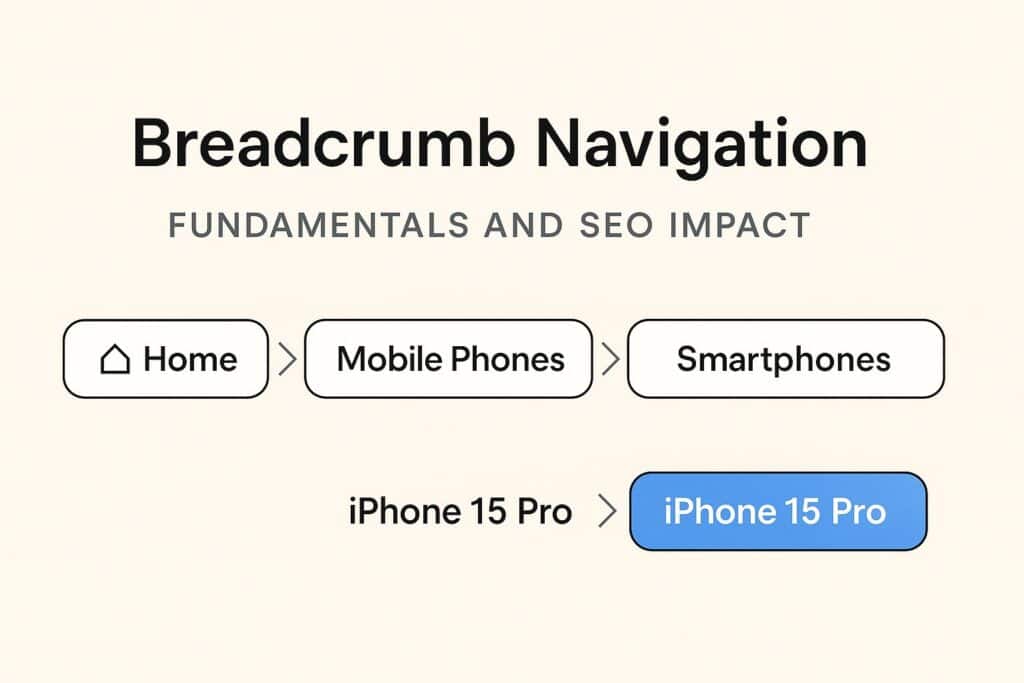
Breadcrumb navigation is the small horizontal trail near the top of a page showing where the visitor sits in the site hierarchy. For Nashville businesses with multi-level structures (practice area to specialty to specific service, or county to neighborhood to location), breadcrumbs do three things at once: they orient users, they help search engines understand site hierarchy, and they create eligibility for enhanced search result displays.
Most Nashville business sites either skip breadcrumbs entirely or implement them as decorative elements without the structured data that makes them count for search. This guide covers correct implementation: visible breadcrumbs, schema markup, accessibility, mobile considerations, and platform-specific setup.
This is technical guidance. The decisions below apply across legal practices, healthcare clinics, multi-location service businesses, restaurants, and ecommerce sites in Nashville. For broader site architecture context, see our Site Information Architecture guide. For internal linking strategy beyond breadcrumbs, see How Internal Linking Structure Can Transform Nashville SEO Performance.
1. What Breadcrumbs Do for Nashville Sites
Three functions, all running simultaneously:
User orientation. A visitor on a deep service page needs to know where they are in the site. A breadcrumb showing Home to Services to Family Law to Custody Disputes makes the location clear and provides one-click paths back up the hierarchy.
Search engine hierarchy signals. Breadcrumbs declare structural relationships between pages. A search engine reading the breadcrumb learns that Custody Disputes is a child of Family Law, which is a child of Services, which sits below the homepage. This explicit hierarchy strengthens topical authority signals.
Rich result eligibility. When breadcrumbs are marked up with structured data correctly, search results can display the breadcrumb path instead of the raw URL. This typically improves click-through rate from search results because the breadcrumb communicates content type more clearly than a URL slug.
For Nashville businesses with deep hierarchies (legal practices with practice area sub-specialties, multi-location service businesses with county and neighborhood pages, restaurants with multiple location and menu sub-pages), all three functions matter and compound. For the broader local search context where these hierarchy signals feed into local pack rankings, see Nashville Local SEO Services.
2. Three Breadcrumb Types
Location-based. Reflects the site’s hierarchical position. Most Nashville business sites should use this type. Example: Home to Practice Areas to Personal Injury to Car Accidents.
Path-based. Reflects the visitor’s actual journey through the site. These create inconsistent experiences because two visitors arriving at the same page through different paths see different breadcrumbs. Generally avoid for SEO purposes.
Attribute-based. Reflects filters or attributes applied (size, color, brand). These are common in ecommerce. Manage carefully because they can create thousands of URL variations that fragment crawl budget.
For most Nashville business sites (legal, healthcare, professional services, multi-location service businesses, restaurants), location-based breadcrumbs handle the standard case correctly. Ecommerce and directory sites should use location-based as default with attribute-based selectively for filter pages where the filter is high-intent.
3. Visual Implementation
Breadcrumbs should be visible, scannable, and consistent in placement.
Placement. Below the main navigation, above the page heading. This is the standard position users expect.
Separator. Right-pointing arrow or chevron. Slashes work but can be confused with URL paths. Whatever separator is chosen, use it consistently across the entire site.
Text styling. Smaller than body text, lighter weight, with clear visual differentiation between clickable parent pages and the current page. The current page should be visually distinct (often non-clickable, sometimes bold or different color).
Hover states. Parent pages should have visible hover states indicating they are clickable. The current page should not.
Color contrast. Meet WCAG AA contrast standards. Light gray text on a white background often fails contrast requirements regardless of how clean it looks visually.
4. Schema Markup for Breadcrumbs
The visible breadcrumb tells users their location. The structured data version tells search engines the same information in a machine-readable format. Both are required for full SEO benefit.
The schema type is BreadcrumbList. Implementation in JSON-LD:
Place the JSON-LD block in the page head or just before the closing body tag. Validate using Google’s Rich Results Test before relying on the markup.
For broader schema validation context across Nashville business sites, including LegalService, LocalBusiness, and FAQPage schema types that interact with breadcrumb structured data, see Top Technical SEO Fixes for Nashville Business Websites.
5. Common Schema Errors
Position numbers must be sequential. Position 1, 2, 3, 4. Not 1, 2, 4, 5. Errors here invalidate the entire breadcrumb in search engine eyes.
Item must be a full URL. Relative paths fail. The full https URL is required.
Name must match visible text. If the visible breadcrumb says “Personal Injury” but the schema says “PI Cases,” the mismatch signals confusion.
Last item. The current page should be included with its name but is conventionally listed without an item URL (or with the same URL). Implementations vary; check Google’s Rich Results Test for current preferred pattern.
Multiple breadcrumb trails. Some sites accidentally inject breadcrumb schema multiple times (once from a plugin, once from a theme). Duplicate breadcrumb schema produces unpredictable search engine behavior.
6. Mobile Breadcrumb Considerations
Mobile screen real estate is limited. Breadcrumbs that work cleanly on desktop often break on mobile.
Truncate long paths gracefully. A four-level breadcrumb on a phone may need ellipsis treatment for the middle levels: Home > … > Personal Injury > Car Accidents.
Tap targets. Each breadcrumb link should meet 44 by 44 pixel minimum tap target size. Cramped breadcrumbs fail on mobile.
Horizontal scrolling. Avoid breadcrumbs that overflow and require horizontal scroll. Truncation handles this better than overflow.
Test on real devices. Browser emulators show what the breadcrumb looks like; real devices show whether it works under thumb pressure.
7. Accessibility Requirements
Breadcrumbs serve users with assistive technology when implemented correctly.
Use a navigation landmark. Wrap the breadcrumb in a <nav> element with appropriate ARIA labeling: aria-label="Breadcrumb".
Use an ordered list. The structure is sequential. Mark it up as <ol> with <li> items. The order matters semantically.
Mark the current page. Use aria-current="page" on the final breadcrumb item to indicate the current location for screen reader users.
Color is not the only signal. Visual differentiation between clickable and non-clickable breadcrumb items should not rely solely on color. Use text styling or non-link element types for the current page.
8. Platform-Specific Implementation
WordPress. Most modern themes include breadcrumb support. Yoast SEO and Rank Math both add breadcrumb features with schema markup. Verify the schema is being output by checking page source for BreadcrumbList JSON-LD.
Shopify. Themes vary. Some output breadcrumbs natively. Others require theme code modifications. Schema markup may need a separate app or theme adjustment.
Squarespace. Native breadcrumb support is limited. Custom code injection is often required for full implementation.
Custom builds. Implement breadcrumbs in the template layer with both visible markup and JSON-LD structured data. Templating handles the variation per page automatically.
For Nashville businesses on legacy platforms, the breadcrumb implementation gap is often the easiest technical SEO improvement available. The work is bounded; the impact compounds across every page in the hierarchy.
9. SERP-Level Differentiation Through Breadcrumbs
Two Nashville sites with similar content rankings can produce different click-through rates from search results based on breadcrumb display.
Display preference. Search results showing breadcrumb paths typically perform better than results showing raw URL slugs because the breadcrumb communicates page context. A search result showing “Home > Family Law > Custody Disputes” reads more clearly than “/family-law/custody-disputes/”.
Hierarchy signals. Sites with consistent breadcrumb implementation across all pages signal organized site structure to search engines. This indirect signal supports overall ranking quality.
Consistency across competitors. In Nashville’s competitive verticals (legal, healthcare, hospitality), breadcrumb implementation is uneven. Sites that implement them correctly differentiate from competitors that skip the implementation entirely.
10. E-E-A-T Through Breadcrumb Implementation
Breadcrumbs contribute to E-E-A-T signals indirectly:
Site quality signal. Sites with proper breadcrumb implementation, valid schema, and accessibility compliance read as professionally maintained. This baseline quality signal supports E-E-A-T evaluation across the site.
Hierarchy clarity. Search engines evaluating expertise need to understand how content relates within a site. Breadcrumbs make these relationships explicit. A practice area with clear hierarchy and proper breadcrumbs reads as more authoritative than the same content on a flat structure. For the semantic content layer that hierarchy signals support, see Semantic SEO Architecture: Structuring Meaning for Scalable Relevance.
User trust. Visitors orient faster on sites with breadcrumbs. Faster orientation reduces bounce rate and supports engagement signals search engines factor into ranking.
11. Common Breadcrumb Mistakes
Patterns observed across Nashville business site audits:
- Breadcrumbs visible to users but with no structured data
- Structured data present but with sequential position errors
- Breadcrumb names that do not match visible text
- Plugin and theme both injecting breadcrumb schema, creating duplicates
- Breadcrumbs broken on mobile due to overflow
- Non-clickable parent pages (technical implementation error)
- Color-only differentiation between current page and links
- Missing on deep pages where breadcrumbs would help most
- Pointing to incorrect parent pages after URL changes
- Schema validation errors that prevent rich result display
Each is fixable. Combined, they explain why most Nashville sites fail to capture the breadcrumb advantage even when they ostensibly have breadcrumbs.
12. Validation and Monitoring
After implementation, verify everything works.
Google Rich Results Test. Paste page URLs and confirm BreadcrumbList shows as detected with no errors.
Google Search Console Enhancement reports. The Breadcrumbs report flags pages with breadcrumb schema errors site-wide. Monitor monthly.
Manual visual check. Click breadcrumb links on multiple pages to verify they navigate correctly.
Cross-device check. Verify breadcrumbs render acceptably on desktop, tablet, and phone. Real devices, not browser emulators.
Schema validation tool. Schema.org validator catches markup errors that Rich Results Test may miss.
Conclusion
Breadcrumbs are small structural elements with disproportionate effect for Nashville businesses with hierarchical content. The implementation cost is bounded; the impact compounds across every page. Sites that implement correctly differentiate from competitors that skip the work or implement it incompletely.
For broader site architecture context, see our Site Information Architecture guide. For internal linking beyond breadcrumbs, see How Internal Linking Structure Can Transform Nashville SEO Performance.
Breadcrumbs are one structural element in the larger architecture system. Done right, they support every other investment.
Written by Nick Rizkalla, Nashville SEO Lead at Rank Nashville. Over 14 years of experience in search visibility for Nashville businesses across legal, medical, multi-location service, and ecommerce industries.
This guide covers technical implementation patterns observed across Nashville business sites. It does not constitute platform-specific implementation advice for individual technical environments.