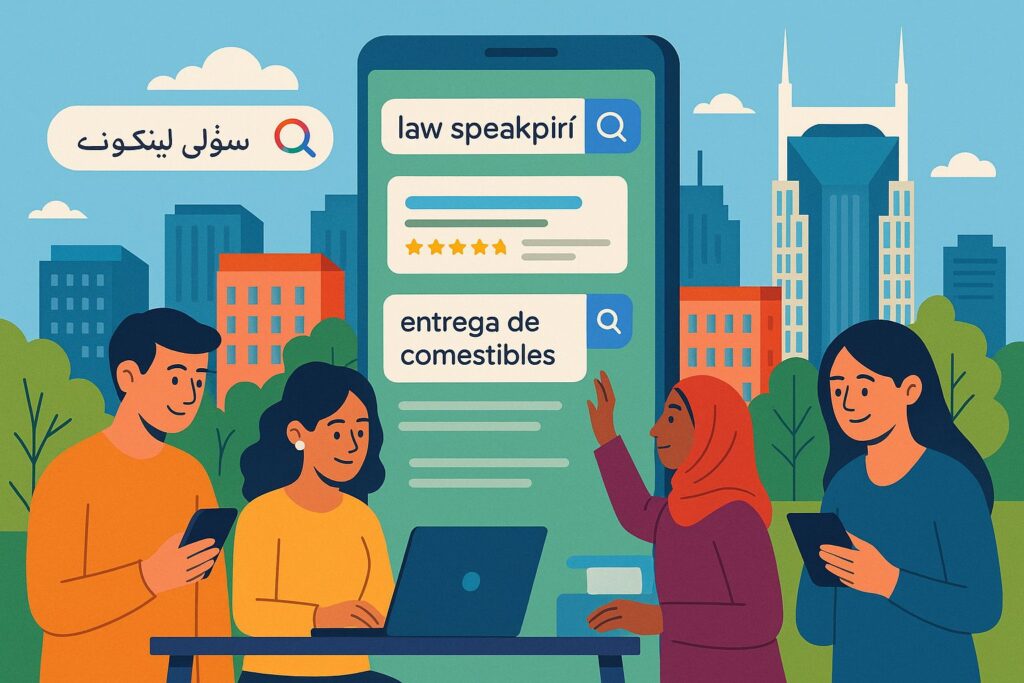
Your customers walk in speaking a language your website does not. They found you because a neighbor told them, because someone at the mosque or the community center mentioned your name. But for every customer who walks through your door on a referral, there are ten more searching on their phone in their own language, and your website does not exist in that search. Not because you do not serve them. Because Google has nothing in their language to show.
Nashville’s foreign-born population exceeds 92,000 according to U.S. Census data, and nearly 38,000 people moved here from other countries between 2020 and 2024. A Kurdish family in Tusculum searching for a pediatrician types Kurdish. A Somali mother on Antioch Pike looking for a tax preparer searches in Somali. An Arabic-speaking father in Nolensville researching family attorneys searches in Arabic. Your English-only website is invisible to all three.
Rank Nashville builds multilingual search visibility for businesses serving Nashville’s international communities. We work with one business per service type per language corridor. Call (615) 988-1309 for a multilingual search audit.
What We Build and How It Works
One business per service type per primary language corridor. If we are building Spanish-language search visibility for a dental practice on Nolensville Pike, we will not take another Spanish-language dental practice on the same corridor. A Kurdish-language legal services campaign in Southeast Nashville and a Spanish-language legal services campaign on Nolensville Pike serve different communities through different languages. That exclusivity protects your investment in each language market.
Native-language content, not translation. Machine translation produces phrases nobody searches. Nashville’s Spanish-speaking community does not search the way a dictionary translates. They search colloquially, regionally, and the difference between the formal term and the phrase people actually type determines whether your page ranks or disappears. We work with native speakers from the specific Nashville communities you serve to build content around the words your customers actually use. Every page is written by a human who speaks the language and knows the neighborhood.
Hreflang architecture. Each language version of your site needs to tell Google exactly what it is: which language, which audience, which version is the default. Without proper hreflang implementation, your Spanish pages compete with your English pages instead of complementing them, or Google treats them as duplicate content and ignores one entirely. We build the technical structure that makes every language version work independently in search while sharing the authority your domain has already earned.
Google Business Profile in multiple languages. Your profile is often the first thing a non-English speaker sees. We build out descriptions, service listings, and Q&A responses in each target language. Reviews in the customer’s language carry more weight with that community than any marketing copy. We set up systems that encourage reviews from customers who speak each language you serve.
Neighborhood language mapping. One Spanish page for all of Nashville ignores the reality of how these communities cluster. Antioch concentrates Spanish, Somali, and Kurdish speakers. The Nolensville corridor serves Arabic and Nepali communities. South Nashville has significant Spanish and Farsi populations. Charlotte Pike has a Vietnamese community with distinct search patterns. Each corridor gets content tailored to its specific language mix and the services that community searches for most. A neighborhood-level approach to search is what separates visibility from invisibility in these markets.
Mobile-first for every script. Non-English searches in Nashville skew heavily toward mobile, consistent with Google’s own data showing that mobile dominates local and multilingual queries worldwide. Each script type requires specific technical adaptations:
- Arabic and Farsi (RTL): Complete right-to-left layout mirroring, reversed navigation, reversed CTA positioning, RTL form alignment
- Somali and Kurdish: Image-led navigation, 48px minimum tap targets, simplified menu structure, clear visual hierarchy
- Chinese and Korean: 18px minimum font size (vs 16px English), wider character spacing, simplified navigation paths
- Spanish and Vietnamese: Standard LTR layout but colloquial keyword targeting, regional dialect adaptation
We build and test for each script on actual devices with the correct keyboards installed, not desktop browser simulations.
What Businesses Serving International Communities Get Wrong
The instinct is understandable: take your English site, run it through Google Translate, publish. It feels like progress. It is not. Google’s algorithms detect auto-translated content through engagement signals: high bounce rates, low time on page, zero return visits. The translated pages either get ignored or actively hurt the domain’s quality signals. A machine translates words. It does not translate how people search.
Others build a single Spanish page and stop. Nashville’s international community is not monolingual. A business on Nolensville Pike that builds Spanish content but ignores the Arabic and Nepali speakers on the same corridor is leaving two-thirds of the opportunity untouched.
The most common technical mistake is missing or broken hreflang tags. Without them, Google does not know which language version to serve to which user. Your Spanish page shows up for English searchers. Your English page shows up for Kurdish searchers. Nobody gets the right result.
And almost nobody adapts for mobile script differences. An Arabic user lands on a page that reads left-to-right and leaves immediately. A Somali user encounters tiny tap targets designed for English text and gives up. The content might be translated correctly but the experience is broken, and broken experience means lost customers.
Nashville’s Language Corridors
Nashville is not a bilingual city. It is a multilingual city with geographic patterns that determine which languages matter for which businesses.
The Antioch corridor (37013) is Nashville’s most linguistically diverse ZIP code and the starting point for most multilingual strategies. Spanish is the primary non-English language, but the Somali and Kurdish communities are substantial and growing independently of each other. A dental practice in Antioch serving all three communities needs three separate content strategies because a Somali mother and a Kurdish father and a Guatemalan teenager search differently, use different terms for the same services, and respond to different trust signals. Peak search times for non-English queries in Antioch shift later than English searches: 7 to 10 PM, when families are home and researching together on a shared device. Businesses here need at minimum two non-English language strategies, and the ones that build all three dominate a market that almost no competitor has entered.
| Corridor | ZIP | Primary Languages | Peak Search Times | Top Search Categories |
|---|---|---|---|---|
| Antioch | 37013 | Spanish, Somali, Kurdish | 7-10 PM | Dental, legal, tax prep, grocery |
| Nolensville | 37135 | Arabic, Nepali | After 6 PM | Medical, legal, financial |
| South Nashville | 37211 | Spanish, Farsi | Evening | Legal, medical |
| Charlotte Pike / West Nashville | 37209 | Vietnamese | Standard hours | Restaurant, auto repair, medical |
| Southeast Nashville / Tusculum | 37210 | Kurdish | 7-10 PM | Medical, legal, automotive |
Nashville has the largest Kurdish population in the United States, with community estimates around 15,000 residents. That community is underserved by virtually every local business website. The Antioch corridor alone concentrates three major language groups, each with distinct search behavior, trust signals, and service priorities.
The businesses that win in these corridors are the ones whose websites exist in the languages these communities search. The ones that do not are invisible to customers who live within walking distance.
What to Expect and What It Costs
Multilingual SEO is more complex than single-language work because every language adds a layer of content, technical architecture, and community-specific research. The first step is language corridor mapping: we identify which languages your customer base actually uses, which ZIP codes they concentrate in, and which services they search for most in their native language. This determines your priority languages and the scope of work.
From there, we build native-language content, implement hreflang architecture, configure your Google Business Profile for each language, and optimize mobile experience for each script type. Each language path is tracked independently in analytics so you can see exactly which communities are finding you and converting.
Multilingual SEO packages start at $2,000 per month for a single additional language. Businesses serving multiple language corridors or requiring three or more languages typically invest between $3,500 and $6,000 monthly. One-time audits are available for businesses that want to understand their current multilingual search position before committing.
We commit to a four-month initial engagement for multilingual work because native-language content requires longer lead times for research, writing, and community validation. After that, month to month. If the engagement ends, every page, every translation, every technical implementation stays with you. The multilingual infrastructure we build is yours permanently.
Call (615) 988-1309 to find out which language communities near your business are searching for your services right now and finding nothing.
Frequently Asked Questions
Which languages should I start with? Start with the language your customer base already speaks. If your walk-in customers include Spanish speakers, start there. If you are in Antioch and serve Kurdish and Somali communities, those are your priorities. We map your customer ZIP codes against Census language data to identify where the opportunity is largest. Most businesses start with one or two languages and expand as results prove the investment.
Is machine translation good enough to start? No. Machine-translated pages consistently underperform because the phrases are technically correct but nobody searches that way. A Nashville Spanish speaker does not search the way a textbook translates. The colloquial search terms are different, and Google ranks the pages that match what people actually type. Native-speaker content costs more upfront but is the only approach that produces real search visibility.
How do I get reviews in other languages? The same way you get English reviews, but in the customer’s language. QR codes at checkout with language-specific review links. Follow-up messages in the customer’s language. Staff who speak the language mentioning reviews naturally at the point of service. Reviews in the customer’s native language build trust with that community far more effectively than translated marketing copy.
Will multilingual pages hurt my English SEO? Not if the technical implementation is correct. Proper hreflang tags tell Google that your Spanish page and your English page are language variants, not duplicate content. Each version ranks independently for queries in its respective language. Done correctly, multilingual pages add search visibility without diluting what your English pages already have.
How long until I see results from multilingual SEO? Non-English local search in Nashville is significantly less competitive than English search. Many of the queries your target community searches have zero or near-zero competition from local businesses. That means properly built native-language pages can rank faster than equivalent English pages. Initial visibility typically appears within 60 days, with meaningful lead flow from non-English search within three to four months.
What if I invest in this and it does not generate new customers? Non-English local search in Nashville has almost no competition. If properly built native-language pages targeting a community of thousands of speakers in your service area do not produce inquiries, the issue is the conversion path, not the visibility. We track each language independently in analytics, and the four-month engagement gives enough time to build, index, and measure real response before you decide whether to continue.
Nick Rizkalla leads our strategy with over 14 years of experience building search systems for multilingual, multicultural, and community-focused businesses across Nashville. Learn more about Rank Nashville, or call (615) 988-1309 for a multilingual search audit.
Rank Nashville 615 Main St. Suite 123, Nashville, TN 37206 (615) 988-1309