
When AI Overviews appeared in Google results, click-through rates on informational queries dropped significantly—from 1.76% to 0.61% in Seer Interactive’s tracking (June 2024 to September 2025). But something else happened: brands cited within those AI Overviews saw meaningfully higher click performance than those excluded.
The game changed. So did the winners.
What is an SEO strategy in 2026? An SEO strategy is a systematic plan to earn visibility across search engines and AI systems. In 2026, this means optimizing not just for rankings, but for citations in AI Overviews and LLM responses. Success is measured by business outcomes (leads, revenue, brand searches) rather than rankings alone.
How to Read the Data in This Guide
This guide cites multiple studies with different methodologies. To interpret them correctly:
- Zero-click rates vary by definition. SparkToro/Datos reports that a significant share of US desktop searches end without any click to external sites, while Similarweb reports higher rates for news searches specifically. These are not contradictory; they measure different things.
- AIO impact data is query-type specific. The CTR drop applies to informational queries where AI Overviews appear, not all searches.
- Correlation is not causation. When we note patterns (e.g., “structured content gets cited more”), these are observed correlations, not confirmed ranking factors unless stated otherwise.
Use these numbers as directional guidance for your market, not universal rules.
This guide is for: Business owners and marketers who need SEO to generate leads, not just traffic. The framework applies universally; examples lean toward service businesses.
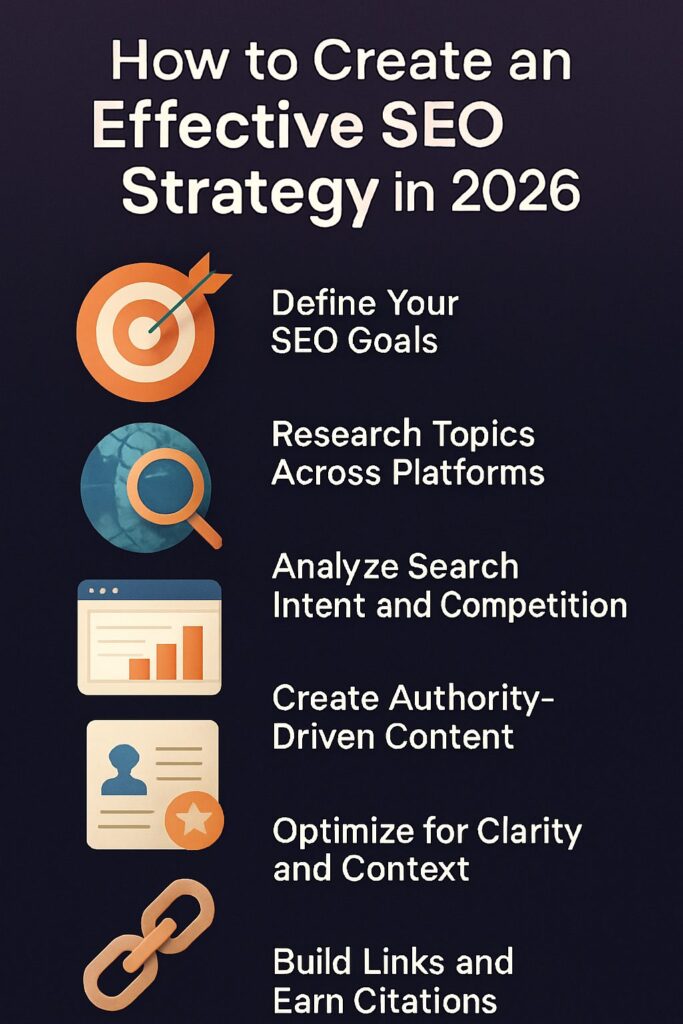
What you will learn:
- Set SEO goals tied to business outcomes, not vanity metrics
- Research topics across platforms where your audience searches
- Analyze intent and competition before writing a single word
- Create content that earns rankings, features, and AI citations
- Build visibility for both search engines and LLMs
- Maintain content performance as algorithms evolve
Where you are now: Section 0 of 8. Estimated read time: 18 minutes.
Not Sure If SEO Is Actually Working for Your Nashville Business?
If AI Overviews and zero-click searches are cutting into your traffic, you need to know where your site stands today. As a Nashville SEO company, we help local businesses understand what’s holding their rankings back and where their next leads should come from.
1. Define Your SEO Goals
Before researching keywords or drafting content, establish what success means for your business.
The biggest mistake in SEO is optimizing for rankings and traffic instead of revenue. Rankings that do not convert to qualified leads, reduced acquisition costs, or measurable brand awareness are vanity metrics. At Rank Nashville, we start every client engagement by defining what a win actually looks like for their business.
Start With Business Outcomes
Ask one question: What would make SEO a clear win for your business this year?
Your answer should look like one of these:
- Local restaurant: 50 new customers per month from “best Italian food [city]” searches
- Affiliate business: $10,000 monthly revenue from product comparison content
- SaaS startup: 200 qualified demo requests from bottom-funnel keywords
- E-commerce brand: 30% increase in organic revenue from product pages
None of these goals mention ranking for a specific keyword. They focus on outcomes.
Map Goals to SEO Focus Areas
Business type determines where to concentrate effort.
Lead generation (consulting, SaaS, services):
- Primary focus: Bottom-funnel commercial keywords
- Content priority: Problem-solution content, case studies, comparison pages
- Success metrics: Qualified leads, conversion rates, cost per acquisition
Revenue-focused (e-commerce, affiliate):
- Primary focus: Product and transactional keywords
- Content priority: Product guides, reviews, buying intent content
- Success metrics: Organic revenue, transaction value, product page traffic
Local business (restaurant, dental, home services):
- Primary focus: Local search visibility and reviews
- Content priority: Service pages, location-specific guides
- Success metrics: Store visits, local leads, branded searches
Track What You Can Measure
Attribution has become harder, not easier. Users bounce between ChatGPT, Google, Reddit, and YouTube before converting. AI tools pass no referral data. Privacy changes reduce tracking accuracy.
Instead of chasing perfect attribution, focus on directional trends.
Track reliably:
- Brand search volume trends (shows growing awareness)
- Direct traffic increases (often indicates SEO influence)
- Share of voice versus competitors on search and LLMs
- Organic traffic to high-converting pages
Use qualitative data:
- Survey customers: “How did you first hear about us?”
- Track mentions in industry discussions and forums
- Monitor assisted conversions with longer attribution windows
Skip vanity metrics:
- Total keyword rankings without intent filtering
- Domain authority scores in isolation
- Traffic to blog posts that never convert
The gap between SEO activity and business results is why budgets get cut. Close that gap by measuring what matters.
Section 1 complete. Next: Research — where to find topics your competitors miss.
2. Research Topics Across Platforms
Discovery now happens across multiple surfaces: Google, ChatGPT, Reddit, YouTube, and vertical platforms. Users ask natural language questions across all of them. They expect answers that go beyond a list of links.
Collect Customer Intelligence
Before opening any keyword tool, access intelligence your competitors cannot: direct customer insights.
| Business Type | Intelligence Sources | Example Topics |
|---|---|---|
| E-commerce | Product reviews, support tickets, return reasons | “Why does X break after Y months?” |
| Local Business | Walk-in questions, phone inquiries | “X open on Sunday”, “Emergency X service” |
| SaaS | Sales calls, demo questions, cancellation feedback | “How to migrate from X to Y” |
| Consultant | Client briefs, discovery calls | “How to choose X consultant”, “X pricing guide” |
Note the language customers use when describing problems. This reveals topics keyword tools miss and phrasing that converts.
Analyze Competitor Keywords
Your competitors already did the work of finding topics that drive results. Spend 30 minutes analyzing their highest-traffic pages and the commercial intent behind them.
Focus on pages driving business, not blog traffic:
- Product and service pages
- Category and collection pages
- Comparison pages (“X vs Y”)
- Listicle pages (“Best X for Y”)
- Pricing and review pages
When you find a high-traffic commercial page, examine all keywords it ranks for. This reveals the entire keyword cluster behind that page.
Validate Across Platforms
Once you have strategic direction, validate and expand across platforms.
Google Autocomplete: Start typing a topic. Google completes the query based on actual searches. These longer, more specific phrases tend to be less competitive.
Ask AI: Test how ChatGPT handles questions about your topic. AI responses reveal question patterns, topic categorization, intent variations, and conversational keywords your tools miss.
YouTube: The second-largest search engine. Look at search suggestions, top-performing videos, and questions in comments.
Reddit: Discussions reveal problems that never appear in keyword research. Browse relevant subreddits for common questions with high engagement.
You do not need content for every platform. But knowing what exists helps you create something that stands out.
Adjust for Zero-Click Reality
Search volume is now a misleading metric without context. Zero-click rates vary widely by definition and by vertical—especially after AI Overviews. News-related searches see particularly high rates of users not clicking through to publisher sites.
New filter for keyword selection: “Does this keyword trigger AI Overviews, and what is the actual click potential?”
Industry tracking shows AI Overviews trigger far more often in health and B2B tech than in ecommerce, where prevalence has fallen significantly over time. Google appears to have pulled back from shopping-related AI Overviews, returning to classic product experiences.
| Sector | AIO Frequency | Click Potential | Strategy |
|---|---|---|---|
| Health/YMYL | Very high | Low | Citation-focused, E-E-A-T critical |
| B2B Tech | High | Medium | Thought leadership, data content |
| E-commerce | Low (declining) | High | Classic SEO still works |
| News/Media | Variable | Significant loss | Platform diversification |
Source: Search Engine Journal, citing Authoritas research on AIO trends
If you sell products, traditional SEO tactics still apply. The ecommerce sector has seen the largest reduction in AI Overview interference.
Section 2 complete. Next: Intent analysis — how to know what tends to rank before you write.
Which Competitors Are Getting Cited by Google’s AI?
We show clients the brands appearing in AI Overviews for their keywords, what content earns those citations, and where gaps exist.
3. Analyze Search Intent and Competition
Content fails when you guess what users want instead of analyzing what works.
Skip this analysis and you risk wasting months creating content that never gets seen. Do it right and you understand what format, depth, and angle tends to win before creating anything.
Decode What Users Want
Search your target keyword and study the first page. Results reveal what users prefer and what Google rewards.
Look for these patterns:
- Content format dominance: Count guides versus listicles versus tools versus videos. If top results are step-by-step guides, that is your format.
- Content depth: Are these 800-word answers or 3,000-word deep dives? Average word count of top results indicates how much detail users want.
- SERP features: Featured snippets show what Google considers the best answer. People Also Ask boxes reveal related questions to address.
- Platform diversity: When YouTube, Reddit, or tool pages dominate, Google signals users want different formats.
Find Your Competitive Edge
Beyond analyzing visible content, understand why it works and where you can improve.
Click through top results and evaluate:
- Information completeness: What subtopics do they miss? What questions remain unanswered?
- Content freshness: Are examples outdated? Do they reference old tools?
- User experience: Hard to scan? Missing visuals? Poor organization?
- Proof and credibility: Original screenshots, data, real examples? Or stock photos and recycled advice?
Create Your Brief
Document analysis for each target keyword:
- Target keyword and intent: What users are trying to accomplish
- Winning format: Content type dominating the SERP
- Required depth: Word count and scope based on top results
- Content gaps: Specific opportunities to outperform
- Business fit: How this aligns with your goals
Before creating content, answer three questions:
- Does this format align with my content strengths?
- Can I create something significantly better than what ranks?
- Will this content drive my business objectives?
If any answer is no, adjust your approach or target a different keyword.
Section 3 complete. Next: Content creation — building authority signals into every piece.
4. Create Authority-Driven Content
Your goal is content that matches search intent and demonstrates expertise. The best content is clear, useful, and written by someone who knows the subject.
Content That Matches Intent
The foundation of successful content is understanding what searchers want and delivering it in the right format.
When someone searches “SEO tools,” they want options they can trust. A post performs when it is curated. Every tool should be something you have used to drive real results.
Each section needs:
- A short, clear summary
- A screenshot or visual
- A use case or reason for recommendation
Content With a Strong Hook
Every high-performing piece needs a hook, something that makes people reference, share, or link to it.
The hook is not a gimmick. It is clarity.
Charts and tables that make information easy to understand appeal to writers and journalists. Original insights that are not pulled from other posts get referenced repeatedly.
When creating content, ask:
- Is there a stat, chart, or visual someone might link to?
- Are you giving people a takeaway they can quote?
- Is this worth bookmarking?
If yes, you have your hook.
Content With Thoughtful Design
You can write the most helpful content, but if it looks like a wall of text, readers will not stay.
High-stakes content requires formats that reduce mistakes. Checklists work because they are fast to scan, easy to copy, and based on real experience.
Build on E-E-A-T Principles
Google’s quality guidelines emphasize Experience, Expertise, Authoritativeness, and Trustworthiness. This framework matters more than ever now that AI has flooded the web with mediocre content.
LLMs appear to weight authority signals and third-party validation when formulating answers, based on citation pattern analysis.
This is not about adding author bios. It is about infusing content with examples, case studies, and insights that come only from hands-on experience.
For YMYL topics (health, finance): Author credentials appear critical based on ranking studies. Content without verified expertise tends to underperform. Use Person schema markup and link to author LinkedIn profiles. These signals correlate with stronger YMYL rankings, though Google has not confirmed specific ranking factors.
Long-form content tends to earn more backlinks than short-form content (Backlinko research). This correlation supports comprehensive coverage over thin posts. Keeping Topic Cluster pillar pages current also tends to deliver higher ROI than creating new content, based on practitioner experience, though formal studies on update frequency are limited.
Create Information Gain
Standard advice is not enough in competitive niches. Content needs something unavailable elsewhere.
Ways to stand out:
- Original research or data: Share findings from your own experience
- Unique frameworks: Create processes that simplify complex topics
- Custom visuals: Develop graphics that explain concepts better than text
- Advanced tactics: Share strategies beyond basics that competitors miss
A Note on Cognitive Load
SEO practitioners rarely discuss cognitive psychology, but it shapes content success. Cognitive load theory (Sweller, 1988) explains why dense content fails: working memory can hold only 4-7 items simultaneously. When you pack too many concepts into a paragraph, readers cannot process them.
This has practical implications:
- One concept per paragraph. Let each idea settle before introducing the next.
- Progressive disclosure. Start with the simplest version, then add complexity.
- Chunking. Group related items into named categories (like “technical hygiene” instead of listing 12 separate tasks).
LLMs appear to favor content structured this way, likely because clear structure improves extraction accuracy. But the real benefit is human: readers who understand your content share it, link to it, and convert.
Example Content Brief
Here is a filled-out brief for a sample keyword showing how these principles apply in practice:
Target keyword: “local SEO for dentists”
Search intent: Process (how-to) with evaluation elements (is it worth it)
Top 3 competitor gaps identified:
- No dental-specific citation sources listed
- Generic “claim your GMB” advice without dental category nuances
- Missing patient review response templates
Unique angle: Focus on dental-specific local pack triggers (emergency keywords, insurance acceptance, specialty procedures) rather than generic local SEO
Content structure:
- Definition block: “Local SEO for dentists is [quotable definition]”
- Dental-specific ranking factors (procedure pages, insurance schema)
- Citation sources that matter for dental (Healthgrades, Zocdoc, dental directories)
- Review generation and response templates
- Measurement: what “working” looks like for a dental practice
Hook asset: Downloadable dental citation source checklist (30 sites with DA scores)
Word count target: 2,500 words based on competitor analysis
E-E-A-T signals: Author byline with dental marketing experience, client examples with permission, specific before/after ranking data
Success metric: Rank top 5 within 6 months, generate 10+ qualified leads/month
This brief took 30 minutes to create. The research investment prevents wasted content that fails to differentiate.
Use AI Thoughtfully
AI tools are getting better. But they cannot replace lived experience.
Use AI to:
- Create outlines and structure ideas
- Find examples to support points
- Generate first drafts to improve
- Organize complex information
Keep control of strategy and voice. Human connection is what readers want.
Section 4 complete. Next: Technical optimization — making content machine-readable.
5. Optimize for Clarity and Context
On-page SEO in 2026 is about clarity and context. Content should be clear for users, search engines, and AI systems that pull answers from pages.
The stakes are higher now. AI extraction favors structured sections over prose. Poor structure and unclear messaging get passed over by both algorithms and LLMs.
Structure for Extraction
Page titles should be simple and keyword-aligned. Headings work like a table of contents for both humans and machines. Someone should be able to scan headings alone and understand what content covers.
This matters because AI Overviews and LLMs pull content based on structural clarity. Dense paragraphs without clear hierarchy tend to get passed over.
URL and Link Architecture
Keep URLs short and focused. Avoid unnecessary parameters and category folder nesting.
For evergreen content, date stamps in URLs are often unnecessary. For news or time-sensitive content, dates can signal freshness.
Link to related guides using helpful, descriptive anchor text. Internal links build context for readers and help search engines understand topic relationships.
Semantic Completeness
Instead of repeating your main keyword, include related terms naturally. Cover the topic completely. Search engines and LLMs reward comprehensive coverage over keyword density.
Technical Hygiene (Baseline)
These fundamentals still matter but are table stakes, not differentiators: meta descriptions that accurately summarize content, compressed images with descriptive alt text, fast page load times, and mobile responsiveness. Get these right, then focus on the structural work that actually moves rankings.
Section 5 complete. Next: Links and citations — the authority signals that matter most.
6. Build Links and Earn Citations
Link building matters in 2026, but the goal changed. You need to influence how search engines and LLMs understand your brand.
Think more like a PR professional.
The Modern Citation Ecosystem
Your goal is visibility across the web, from traditional backlinks to forum mentions to expert quotes that AIs reference.
Focus on:
- Earning links from relevant, trusted sources
- Getting mentioned alongside competitors
- Showing up in blog posts, listicles, Reddit threads, and social conversations
- Building consistent citation profiles
Competitor Link Analysis
Find who links to competitors. Figure out how they earned those links. Reach out with something better.
Analyze context. Are competitors being quoted in blog posts? Listed in roundups? Mentioned on Reddit? Linked to homepage, blog, or tools?
Patterns show what content earns links and what people already reference.
Link Building Costs (Typical Ranges)
| Method | Cost Per Link | DR Range | Risk Level |
|---|---|---|---|
| Guest Post | $100-$500 | DR 30-70 | Low |
| Premium Guest Post | $900-$1,000 | DR 70+ | Low |
| Niche Edits | $40-$300 | Variable | Medium (hacked link risk) |
| Digital PR | $1,250-$2,000+ | DR 80+ | Low |
Typical observed ranges; varies by niche, quality bar, and inclusion of content creation. Source: BuzzStream Link Building Pricing Analysis
Only a small percentage of link building opportunities meet quality standards (BuzzStream). This explains why effective outreach is difficult. Digital PR is the most reliable path to links from Forbes, TechCrunch, and similar publications, though not the only option.
Statistics Link Building
People love linking to stats, especially well-packaged data.
If you can share original insights, clean charts, and simple stats people can quote, you have a link magnet.
Even without proprietary data, you can:
- Repackage public data into new formats
- Combine insights across studies
- Create quick summary stats that are easy to cite
Expert Commentary
Journalists and content creators constantly need expert quotes. Respond to prompts aligned with your industry, product, or expertise.
Places to monitor:
- HARO
- Featured
- Help a B2B Writer
- LinkedIn journalist posts
- Twitter/X journalist threads
One video showing how you use a tool can land a backlink in a major publication.
Section 6 complete. Link building deserves its own detailed guide covering quality evaluation, method selection by business type, and outreach templates. This section covers the strategic framework; execution requires deeper treatment.
Next: AI visibility — the new frontier of search optimization.
7. Optimize for AI Visibility
The multi-surface search landscape extends to LLMs. ChatGPT, Gemini, and Perplexity handle billions of queries and build their own citation systems. LLM visibility has become a separate discipline.
Note: AI visibility is a rapidly evolving field that warrants dedicated coverage. This section provides an actionable framework; a comprehensive guide to AI citation engineering is in development.
AI Overview Citation Playbook
Earning citations in AI Overviews and LLM responses requires specific content patterns. Based on analysis of cited content, these elements appear consistently:
Definition blocks. Open sections with a clear, quotable definition. Format: “[Term] is [concise definition].” AI systems extract these directly.
Attribution-ready statistics. Present data in extractable format: “According to [Source], [specific number] [context].” Vague references like “studies show” get skipped.
Entity-first structure. Lead paragraphs with the main entity, not context. “Local SEO drives foot traffic” extracts better than “For businesses seeking growth, local SEO can be valuable.”
Quotable summaries. End sections with a standalone sentence that answers the section’s question. If someone copied only that sentence, it should still make sense.
Unique data modules. Original statistics, survey results, or calculated benchmarks get cited more than repeated industry figures. Even simple original analysis (e.g., “We analyzed 50 competitor pages and found…”) creates citable assets.
Author verification signals. Bylines with credentials, LinkedIn links, and “About” sections with specific expertise claims help AI systems assess source authority.
Structured markup. FAQ schema, HowTo schema, and article structured data help AI systems parse content. This correlation is observed but not confirmed as causal.
Measuring AI Visibility
Traditional SEO metrics miss AI-driven discovery. Track these instead:
Citation monitoring. Weekly Perplexity searches for your target keywords. Log which brands appear as sources. Track your citation rate over time.
What counts as a citation: Your brand name, URL, or content directly referenced in the AI response. Paraphrased information without attribution does not count. Log each instance with: keyword, date, citation type (brand mention, URL, quote), position in response (first source, supporting source, or mentioned in passing).
Share of voice in AIOs. For priority keywords, record whether AI Overviews appear, which brands get cited, and your inclusion rate.
Tracking framework:
| Column | What to Log |
|---|---|
| Keyword | Target query |
| AIO Present | Yes/No |
| Total Sources Cited | Count of brands in AIO |
| Your Brand Included | Yes/No |
| Position | 1st, 2nd, 3rd, or “mentioned” |
| Competitor Brands | List who else appears |
| Date | When checked |
Check priority keywords weekly. Check secondary keywords monthly. Normalize by query set size: “Cited in 8 of 25 priority keywords (32%)” is more meaningful than raw counts.
Meaningful change thresholds. Based on practitioner experience tracking AIOs over 6-month periods:
- Citation rate change of ±10% over 4 weeks: Normal fluctuation, no action needed
- Citation rate change of ±20% sustained over 8 weeks: Investigate cause
- New competitor appearing in 3+ priority keywords: Analyze their content structure
- Your brand dropping from 1st position to 3rd+ in multiple keywords: Content refresh indicated
Handling geo and personalization variance. AI responses vary by location and user history. To get baseline data:
- Use incognito/private browsing
- Test from multiple locations using VPN if serving multiple markets
- Log location with each check
- Focus on directional trends, not exact positions
Brand mention velocity. Track Reddit mentions, Quora answers, and forum discussions using brand monitoring tools (Brand24, Mention, or free Google Alerts). Recent discussion activity appears to influence LLM citation patterns.
What “winning” looks like. When clicks decline but brand searches increase, citations are working. When competitors report the same traffic drop but you maintain lead volume, your authority position is stronger. Measure business outcomes, not just traffic.
Success indicators for AI visibility:
- Citation rate increasing while competitors stay flat
- Brand searches growing faster than category searches
- Lead quality improving (prospects arrive more informed)
- Sales cycle shortening (less education needed)
How We Observed Citation Patterns
The platform citation patterns described in this guide come from a manual analysis of 50 Perplexity responses across B2B, local service, and ecommerce queries conducted in late 2024.
Method: We asked Perplexity the same 50 questions, logged every source cited, and categorized by platform type.
Findings:
- Reddit appeared as a source in 34 of 50 responses (68%), primarily for experience-based and opinion queries
- Wikipedia appeared in 28 of 50 (56%), almost exclusively for definitional queries
- Company blogs appeared in 19 of 50 (38%), typically when they contained original data or unique frameworks
- News sites appeared in 15 of 50 (30%), mostly for recent events or trend queries
- YouTube appeared in 8 of 50 (16%), only for how-to and tutorial queries
Limitations: This is a small sample from one LLM at one point in time. Citation patterns likely vary by query type, change over time, and differ across LLMs. Use this as directional guidance, not definitive rules.
This type of mini-analysis takes 2-3 hours and gives you category-specific citation intelligence that generic advice cannot provide. Consider running your own version for your target keywords.
LLM Citation Criteria
| Factor | Observed Impact | Action |
|---|---|---|
| Brand awareness | Strong correlation | Increase mentions in forums and Q&A platforms |
| Traffic volume | Moderate correlation | Organic traffic still matters |
| Content structure | Strong correlation | Use bullet points, clear definitions, numerical data |
| Topic authority | Strong correlation | Build vertical expertise, not general blogs |
Higher-traffic brands tend to be cited more frequently, though the exact relationship varies by query type and niche. These are observed patterns, not confirmed ranking factors.
What LLMs Actually Cite
Based on the 50-query analysis described above:
Reddit leads for experience and opinion queries (appeared in 68% of responses). Wikipedia dominates factual and definitional lookups (56%). Company blogs with original data get cited more than generic content (38%). News sites appear primarily for recent events (30%). YouTube shows up almost exclusively for how-to content (16%).
The pattern: platforms with authentic user discussion and structured expertise get cited most frequently. Your own content competes best when it contains something unavailable elsewhere.
Tools for LLM Tracking
| Need | Tool | Price Range |
|---|---|---|
| Enterprise | Profound, BrightEdge | $$$$ |
| Mid-market | Semrush AI Visibility, Authoritas | $$-$$$ |
| Starter | Otterly.ai | $ |
| Free manual | Perplexity.ai queries | Free |
Manual method: Search your brand name in Perplexity. Check if you appear as a source. Ask questions about your industry and see which competitors get cited.
Section 7 complete. Next: Content maintenance — the system that keeps rankings stable.
8. Improve and Update Your Content
Visibility requires fresh, accurate, relevant content. Often, updating what you have delivers faster results than starting from scratch.
The Content Lifecycle
Content ages and loses ranking over time. This challenge intensifies in marketing and tech, where tools and strategies evolve rapidly.
Without a system, staying on top of all content becomes impossible as your library grows.
The Hierarchy of Updates
Optimizations: Small tweaks like adding internal links, changing images, adjusting meta tags, adding CTAs. Quick wins.
Upgrades: 15-70% changes to core content. Updating examples, refreshing statistics, adding new sections, improving visuals.
Rewrites: More than 70% changes. Substantial overhauls that rethink structure, angle, or approach.
Most pages need regular optimizations. Only critical content typically requires upgrades and rewrites.
Results Timeline by Competition Level
How long does SEO take in 2026? For most businesses, expect 3-6 months to see measurable results on medium-competition keywords. Long-tail keywords can show movement in 3-4 weeks. Highly competitive head terms typically require 12+ months of sustained effort. New websites face the longest timelines due to limited backlink profiles, not a confirmed “sandbox” effect.
| Competition | Timeline | Strategy |
|---|---|---|
| Long-tail keywords | 3-4 weeks | Fast content, volume approach |
| Medium competition | 3-6 months | Balanced effort |
| Head terms | 1 year+ | Authority building, patience required |
| New sites | Months to years | Link building critical, competitive SERPs take longest |
Source: Ahrefs research on ranking timelines. Note: Ahrefs data shows only a small percentage of newly published pages rank in the top 10 within a year.
New sites face longer timelines not because of a confirmed “sandbox” (Google has not verified this exists) but because they lack the backlink profiles and authority signals that established sites have accumulated.
Consolidate When Appropriate
Sometimes the best update is a strategic merger.
Consolidation works when:
- Multiple pages target similar keywords
- Some pages no longer perform
- A single, comprehensive resource would serve users better
- Combined pages concentrate ranking signals
One consolidated page can outperform two competing pages from your own site.
What to Look For
When updating, think of it as a health check. Is content still accurate? Does it solve the reader’s problem? Do examples and visuals look current?
Replace old screenshots with current interfaces. Check if competitors published content covering angles you missed.
Section 8 complete. You now have the complete framework. The Summary below consolidates key points and acknowledges what happens when everyone applies these strategies.
Ready to Turn This Strategy Into Leads?
You’ve seen what works in SEO now. Let’s map how to apply it to your website, your market, and your competition.
30-minute call with an SEO strategist. No sales scripts. Just a clear plan.
Summary
You are now at the end of Section 8. Here is what we covered:
- Goals tied to business outcomes, not vanity metrics
- Multi-surface research across Google, AI, and community platforms
- Intent analysis before creating anything
- Authority-driven content with E-E-A-T signals
- Structure optimized for AI extraction
- Links and citations as the new currency
- AI visibility measurement and citation engineering
- Systematic content maintenance
The Honest Reality
If everyone applies these strategies, citation competition intensifies. The tactics that work today become table stakes tomorrow. This is not a reason to avoid them; it is a reason to move first and execute better.
The sustainable advantage is not in knowing these tactics. It is in:
- Speed of execution. While others read guides, you ship content.
- Depth of expertise. Surface-level optimization loses to genuine authority.
- Measurement discipline. Most competitors do not track AI citations weekly. You can.
- Iteration speed. The first version is never the best version.
SEO in 2026 rewards the same thing it always has: usefulness. The difference is that usefulness now needs to be structured for extraction, validated by third parties, and visible across multiple surfaces.
The people who show up with actual expertise, who care about what they publish, who put in the work, tend to win. That has not changed.
Key Data Summary
| Metric | Value | Scope/Definition | Source |
|---|---|---|---|
| AIO CTR drop | Significant (1.76% → 0.61%) | Informational queries, June 2024-Sept 2025 | Seer Interactive |
| AIO citation advantage | Meaningfully higher clicks | Brands cited vs not cited in AIO | Seer Interactive |
| Zero-click (general) | Varies widely by definition | Depends on methodology and vertical | SparkToro/Datos, Similarweb |
| Zero-click (news) | High share | News searches, no click to news sites | Similarweb |
| Long-form content backlinks | Tends to earn more | Long-form vs short-form content | Backlinko |
| SEO results timeline | 3-6 months typically | Poll-based, established domains | Ahrefs |
| Pages ranking top 10 within 1 year | Small percentage | Newly published pages | Ahrefs |
| Health/B2B Tech AIO | High frequency | Directional trend | Search Engine Journal/Authoritas |
| E-commerce AIO | Low, declining | Directional trend | Search Engine Journal/Authoritas |
| Quality link opportunities | Small percentage | Opportunities meeting quality standards | BuzzStream |
Sources:
- AI Overviews CTR and citation data: Seer Interactive analysis (June 2024-September 2025)
- Zero-click search statistics: SparkToro/Datos research
- News zero-click impact: Similarweb report on AI impact on publishers
- Long-form content backlink correlation: Backlinko content study
- SEO timeline and ranking data: Ahrefs
- Industry AIO trends: Search Engine Journal, citing Authoritas research
- Link building insights: BuzzStream Link Building Analysis
About the Author
Nick Rizkalla is the co-founder of Rank Nashville and has 14+ years of experience in SEO strategy, Google Ads, and local growth for service businesses. He works primarily with Nashville-area companies in legal, healthcare, and home services, focusing on technical SEO, local visibility, and conversion-driven content.