
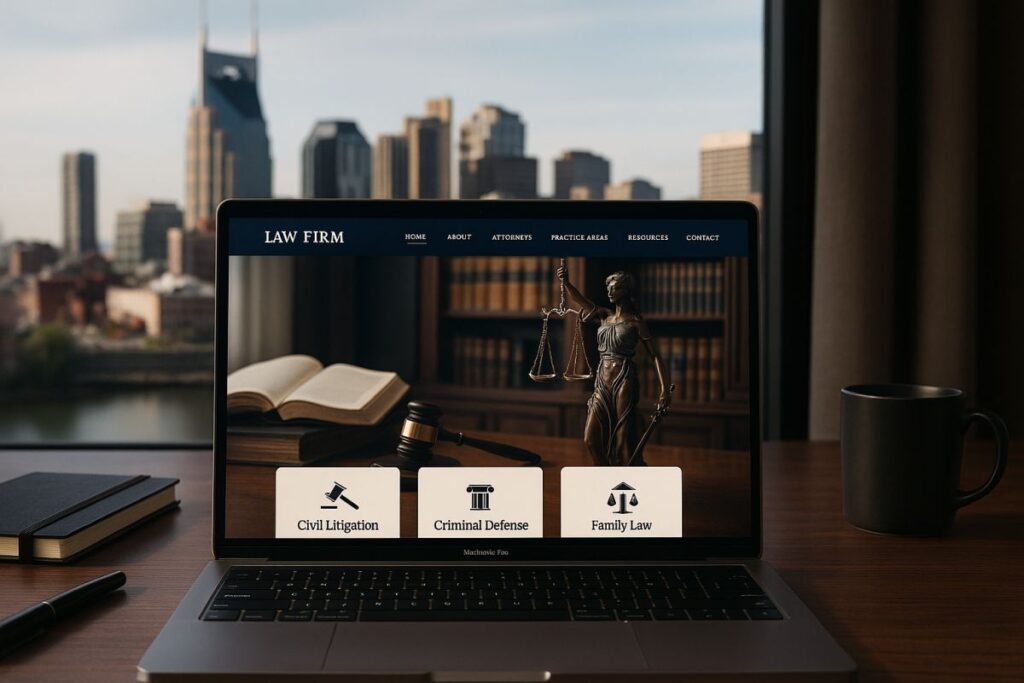
A law firm website is not successful because it looks expensive. It succeeds when the right person can recognize that the firm handles their problem, trust what they see, and take the next step without confusion.
That sounds simple. It rarely is.
A Nashville law firm website may need to serve an injured person searching from a hospitavately over several weeks, a business owner comparing credentials, and another attorney deciding whethers with a different level of urgency, knowledge, and risk.
That te redesign cannot begin with colors, photography, or a homepage mockup. It has to begin with the firm’s economics, intake process, practice priorities, ethical constraints, and the decisions a prospective client must make before contacting an attorney.
This is the framework Rank Nashville uses to plan that work.
Start With the Cases the Firm Actually Wants
The first design question is not, “What should the site look like?”
It is:
Which matters should this website help the firm attract?
A firm may want more personal injury cases, fewer low-value family-law inquiries, stronger criminal-defense calls after business hours, or more qualified referrals in a narrow business-law category. Those goals produce different sites.
Before architecture or copy begins, define:
-
The practice areas the firm wants to grow
-
The matters the firm does not want
-
The geographic area it can realistically serve
-
The attorney or team responsible for each matter type
-
The value and capacity of each practice area
-
The action a qualified visitor should take
-
The information intake needs before accepting a consultation
This prevents a common failure: building a website that generates more inquiries without improving the number of matters the firm can or wants to accept.
A successful site should not merely increase contact volume. It should improve the fit between the visitor, the matter, and the firm.
Define Conversions Beyond Calls and Forms
Phone calls, contact forms, and consultation bookings are important. They are not interchangeable.
A phone call may indicate immediate intent, but it may also be an unqualified inquiry. A form submission may represent careful research rather than lower intent. An online booking is only valuable if the prospect attends and meets the firm’s intake criteria.
The website should therefore be measured through the full intake path:
-
Calls, forms, chats, and bookings
-
Qualified consultations
-
Attended consultations
-
Matters accepted by the firm
-
Signed engagements
-
Expected value by practice area
This distinction matters because the page producing the most leads may not produce the best cases.
Rank Nashville plans measurement around the firm’s actual intake process rather than stopping at a form-confirmation screen. The goal is to identify which pages and channels produce qualified opportunities, where good prospects abandon the process, and whether the firm can respond quickly enough to convert the demand the website creates.
Sensitive client and matter information should remain inside approved intake, CRM, or financial systems. Analytics and advertising platforms should receive only the minimum de-identified conversion information required for measurement.
Design for Four Different Evaluation Modes
A law firm does not have one website visitor. It has several types of decision-maker using the same pages for different reasons.
The urgent visitor
This person may be dealing with an arrest, collision, injury, protective-order issue, or another event that requires immediate help.
They need:
-
Immediate confirmation that the firm handles the problem
-
A visible phone number
-
Accurate availability information
-
A short explanation of what happens next
-
Reassurance about confidentiality
-
A contact path that works on a phone under stress
The page should not force this visitor through a long brand story before showing how to get help.
The research-oriented visitor
This visitor is comparing experience, process, fees, likely next steps, and the people who may handle the matter.
They need:
-
Detailed practice-area information
-
Named attorneys and relevant credentials
-
A clear explanation of the engagement process
-
Realistic discussion of timing and uncertainty
-
Evidence that the firm understands Tennessee and Nashville-specific issues
-
A reason to choose this firm rather than another competent option
This visitor may return several times before contacting anyone.
The comparison shopper
This person already knows they need legal help and is deciding between firms.
They are likely to compare:
-
Attorney experience
-
Practice focus
-
Reviews
-
Fee structure
-
Responsiveness
-
Office location
-
Consultation options
-
Case results, where appropriate
-
The clarity and professionalism of each firm’s website
The site should make comparison easier without turning the firm into a list of unsupported superlatives.
The referral source
Another attorney, medical professional, advisor, or former client may be evaluating whether the firm is a safe referral.
They need a faster path to:
-
Attorney biographies
-
Bar admissions and credentials
-
Practice boundaries
-
Referral contact information
-
Professional involvement
-
Representative experience
-
Clear indications of who handles what
A referral source should not have to browse consumer-focused FAQs to determine whether the firm is appropriate for a matter.
Map Journeys, Not Just Personas
Personas describe who is visiting. Journeys describe what that visitor must accomplish.
A personal injury prospect may begin on a page about a specific accident type, review the attorney’s background, check case-result language and disclaimers, read reviews, then call.
A criminal-defense visitor may arrive late at night, look for immediate availability, check whether the firm handles the specific charge, and call without visiting another page.
A family-law prospect may read several guides over multiple visits, compare attorney biographies, review the consultation process, and submit a form only after deciding that the firm’s communication style feels appropriate.
A referral source may enter directly through an attorney biography, confirm the practice focus, and use a dedicated professional contact path.
A comparison shopper may move between the homepage, practice-area page, reviews, attorney biography, fees or consultation information, and contact page before choosing.
When Rank Nashville plans a law firm site, we map these paths before finalizing navigation or calls to action. That keeps the information architecture tied to real decisions instead of forcing every visitor through the same funnel.
Build Navigation Around Client Problems
Law firms often organize websites around internal structures that make sense to attorneys but not to clients.
Navigation should use language prospective clients recognize.
A practical top-level structure may include:
-
Practice Areas
-
Attorneys
-
Results or Experience
-
Reviews
-
Resources
-
About
-
Contact
Not every firm needs all seven. The correct structure depends on the number of attorneys, practice areas, locations, and content assets.
Practice-area architecture
Each priority practice area should have a clear hub page. More specific matter types can sit underneath it when they serve distinct search intent and provide genuinely different information.
A criminal-defense section might separate DUI, domestic assault, drug charges, theft, and white-collar matters. A family-law section might separate divorce, custody, support, modifications, and high-asset cases.
Do not create a separate page simply because a keyword exists. Create it when the visitor’s questions, evidence, process, or decision criteria differ enough to justify a dedicated resource.
Attorney pages
Attorney biographies should do more than reproduce a résumé.
A useful biography explains:
-
What the attorney handles
-
Who the attorney represents
-
Relevant experience and credentials
-
Bar admissions
-
Professional involvement
-
How the attorney approaches the work
-
Which pages or resources the attorney authored
-
How to contact or request a consultation
Credentials build trust when they help the reader evaluate fit. A wall of badges without context does not.
Persistent contact options
The primary contact path should remain easy to find, especially on mobile.
That may include:
-
A clearly labeled phone number
-
A concise contact form
-
Online consultation scheduling
-
After-hours instructions
-
A sticky mobile contact control
-
Separate referral contact information
The site should display only availability the firm can actually honor. “Available 24/7” is not a design flourish. It is an operational promise.
Treat the Homepage as a Routing Page
The homepage should not attempt to explain every practice area in equal depth.
Its job is to answer four questions quickly:
-
What does this firm handle?
-
Who does it serve?
-
Why should the visitor trust it?
-
What should the visitor do next?
A strong law firm homepage usually needs:
-
A specific value proposition
-
Priority practice areas
-
Named attorneys or a clear path to them
-
Evidence supporting the firm’s positioning
-
Reviews or results presented responsibly
-
A clear geographic and jurisdictional scope
-
Multiple contact options
-
A route for visitors who need more information before contacting the firm
Generic claims such as “aggressive representation,” “personalized service,” and “experienced attorneys” rarely differentiate a firm because competitors use the same language.
Specificity is more persuasive:
-
The matters the firm handles
-
The clients it is built to serve
-
The stage at which the firm becomes involved
-
The attorney who will lead the work
-
The practical problem the firm is equipped to solve
Publish Content a Nashville Client Can Actually Use
Legal content should not exist merely to create more indexed pages.
Each resource should help a prospective client understand a real decision, process, risk, or next step. It should also demonstrate that the firm knows Tennessee law and the Nashville legal environment without pretending that local references alone create expertise.
Useful local content may explain:
-
What happens after an arrest in Davidson County
-
How a Tennessee divorce consultation is typically prepared
-
What information an injured person should preserve after a collision
-
How local court location and scheduling affect the client’s next step
-
Which facts change the way a particular Tennessee rule may apply
-
What the firm can and cannot determine before reviewing the matter
Local detail must be accurate and useful. References to Broadway, I-440, Green Hills, or Davidson County should not be pasted into generic text merely to create geographic relevance.
The same rule applies to neighborhood pages. A separate Green Hills or Belle Meade page is justified only when it serves a distinct audience, office location, service pattern, or body of genuinely local information.
Make Trust Verifiable
A law firm website asks visitors to disclose sensitive information and make a high-stakes professional decision. Trust cannot be left to design aesthetics.
Trust elements may include:
-
Named attorneys
-
Accurate biographies
-
Bar admissions
-
Professional memberships
-
Authored legal resources
-
Real office and contact information
-
Genuine client reviews
-
Media or community involvement
-
Representative experience
-
Clearly explained consultation and fee arrangements
Case results can help visitors understand experience, but they require context and appropriate disclaimers. A result should never imply that another client will receive the same outcome.
Testimonials should be genuine, accurately presented, and reviewed under current professional-responsibility rules. Do not selectively edit a statement until it communicates something the client did not actually say.
Tennessee’s rules governing communications about legal services prohibit false or misleading claims. Website language concerning results, fees, comparisons, specialist status, urgency, availability, and likely outcomes should be reviewed against the current Tennessee Rules of Professional Conduct before publication.
Compliance should be designed into the site. It should not be patched into the footer after the marketing copy has already made claims the firm cannot support.
Build for Mobile Stress, Not Just Mobile Screens
Many legal searches happen on phones, but “responsive” does not automatically mean usable.
A mobile law firm site should account for:
-
One-handed navigation
-
Emotional stress
-
Poor network conditions
-
Small screens
-
Interruptions
-
Limited patience
-
Accessibility needs
The phone number should be clickable. Forms should support autofill and ask only for information needed at that stage. Labels should remain visible after a user begins typing. Error messages should explain how to fix the problem.
Interactive controls should be comfortably sized and spaced. WCAG 2.2 generally uses 24×24 CSS pixels as the minimum target-size standard, subject to listed exceptions. In practice, larger targets, often around 44×44 pixels, are easier to use on a phone.
Accessibility requires more than tap-target size. The build should also address:
-
Keyboard navigation
-
Visible focus states
-
Color contrast
-
Form labels
-
Heading order
-
Alternative text
-
Error identification
-
Zoom and reflow
-
Captions and transcripts where needed
Accessibility should be tested during design and development, not treated as a plugin installed at launch.
Make Speed a Conversion Requirement
Google’s Core Web Vitals measure loading performance, interaction responsiveness, and visual stability.
The published “good” thresholds are:
-
Largest Contentful Paint of 2.5 seconds or less
-
Interaction to Next Paint of 200 milliseconds or less
-
Cumulative Layout Shift of 0.1 or less
These measurements are assessed at the 75th percentile of real-user visits. A fast laboratory test on one device does not prove that actual visitors receive a good experience.
Core Web Vitals are not a ranking switch, and passing them does not guarantee visibility. They still matter because a slow or unstable page creates friction at the moment a prospective client is deciding whether to trust and contact the firm.
Performance work may include:
-
Correctly sized and compressed images
-
Modern image formats
-
Controlled font loading
-
Reduced third-party scripts
-
Stable dimensions for media and embeds
-
Efficient hosting and caching
-
Careful use of chat, call-tracking, review, and scheduling widgets
-
Testing on real devices and slower network conditions
The Rank Nashville build process treats performance as an architectural constraint. It is tested before launch and monitored after third-party marketing tools are added, because those tools often undo the speed gains made during development.
Use Structured Data for Clarity, Not Theater
Structured data helps search engines interpret information on a page. It does not prove expertise and does not function as a ranking shortcut.
Depending on the firm and page, useful markup may include:
-
Organizationor an appropriateLocalBusinesssubtype for the firm -
Personfor individual attorneys -
Articlefor authored legal resources -
BreadcrumbListfor site hierarchy
The marked-up information must match what users can see on the page.
Do not promise FAQ rich results. Google stopped showing the FAQ rich-result feature on May 7, 2026. FAQ content can still help users, but adding FAQPage markup no longer creates that Search feature.
Review markup also requires caution. Google does not generally award self-serving review stars to a local business for reviews displayed on its own site. Reviews should be included because they help prospective clients evaluate the firm, not because someone promises decorative stars in the search results.
Schema implementation should be validated, inspected after deployment, and maintained when the firm’s attorneys, address, contact information, or site structure change.
Design Calls to Action Around Readiness
“Contact Us” is not the only possible call to action, and “Free Consultation” is not automatically the best one.
Different visitors may be ready to:
-
Call now
-
Request a consultation
-
Book a time
-
Ask a question
-
Read about the process
-
Review attorney credentials
-
Download a preparation checklist
-
Send a professional referral
The call to action should match the page and the visitor’s likely state.
A criminal-defense page may prioritize immediate contact. A family-law page may need to explain confidentiality and consultation expectations before presenting a form. An attorney biography may offer a direct consultation path and a route to related practice areas.
Every viewport does not need a flashing button. It needs a clear next step.
Keep forms short, but not blind
A first-contact form should collect enough information to route and respond without demanding a full case history.
Typical fields may include:
-
Name
-
Preferred contact method
-
Phone or email
-
General matter type
-
A short message
-
Conflict-related information only when the firm’s process requires it
The form should warn users not to submit confidential or time-sensitive information before an attorney-client relationship exists. The exact language should be approved by the firm.
Detailed intake belongs in a secure process after initial contact, not in a marketing form connected to multiple third-party platforms.
Connect Design to Intake Operations
A website cannot outperform the system receiving its leads.
Before launch, determine:
-
Who answers calls
-
What happens after hours
-
How quickly forms are reviewed
-
How consultation requests are assigned
-
Which inquiries are qualified
-
How rejected matters are recorded
-
Whether referral sources receive a different response path
-
How missed calls are recovered
-
What information reaches the CRM
-
Which outcomes can be attributed back to the website
A high-converting page can still fail commercially if calls go unanswered or qualified prospects wait two days for a response.
This is why Rank Nashville treats the intake path as part of website strategy. The conversion does not end when a button is clicked. It ends when the firm can identify whether the site contributed to a qualified consultation and, ultimately, an accepted matter.
Measure Business Outcomes, Not Decorative Engagement
Traffic, rankings, scroll depth, and time on page can help diagnose behavior. They do not establish business value by themselves.
The most useful website reporting connects:
-
Landing page
-
Traffic source
-
Call or form event
-
Practice area
-
Qualified consultation
-
Attendance
-
Signed engagement
-
Response time
-
Call-answer rate
-
Intake outcome
This does not require placing confidential case details in Google Analytics or advertising platforms. Sensitive information should remain in approved systems and be connected through de-identified records where appropriate.
The reporting question is not merely:
How many leads did the site generate?
It is:
Which pages and channels produced the matters the firm wanted, and where did otherwise qualified prospects disappear?
Test Without Pretending Every Site Has Enterprise Traffic
Testing is valuable. Fake statistical certainty is not.
Many local law firm websites do not receive enough comparable conversion volume to run a clean, high-confidence A/B test on every headline, button, or form variation.
A practical testing program prioritizes high-impact changes:
-
Homepage positioning
-
Practice-area headlines
-
Contact options
-
Form length
-
Mobile contact controls
-
Attorney-page calls to action
-
Fee and consultation explanations
-
Intake response time
Change one major variable where possible, document the date, and compare qualified outcomes over a meaningful period. Segment by practice area because the behavior of an urgent criminal-defense prospect may not resemble that of a family-law researcher.
When volume is insufficient for a formal experiment, use controlled iteration rather than calling the result statistically proven.
Differentiate With Evidence the Firm Can Own
Nashville firms compete against national brands, established local practices, referral-driven boutiques, and aggressive advertisers.
A sustainable website advantage cannot depend only on a visual style that competitors can copy.
It should come from assets the firm can legitimately own:
-
A defined practice focus
-
Recognizable attorneys
-
First-hand professional experience
-
Useful Tennessee-specific explanations
-
Real local involvement
-
Clear intake and communication standards
-
Original resources
-
Strong reviews
-
Earned references
-
A point of view on the work
Local knowledge can be a meaningful differentiator, but it must be demonstrated rather than announced.
A national firm can insert “Nashville” into a heading. It is harder to publish accurate, useful explanations of Tennessee law, Davidson County processes, local institutions, and the practical questions Nashville clients actually ask.
Rank Nashville’s role is to help extract that knowledge from the firm and turn it into site architecture, attorney pages, service content, and decision tools. We do not manufacture local expertise on the firm’s behalf. The attorneys must supply the experience, judgment, and facts that make the positioning defensible.
Use a Phased Build, Not a Generic Twelve-Week Promise
The implementation sequence should remain stable even when timing changes.
Phase 1: Discovery and measurement
-
Define practice priorities
-
Review current traffic and leads
-
Map intake operations
-
Inventory existing pages
-
Identify compliance requirements
-
Establish measurement and privacy boundaries
-
Map visitors and journeys
Phase 2: Architecture and conversion planning
-
Build the sitemap
-
Define page roles
-
Plan navigation
-
Map internal links
-
Assign conversion paths
-
Determine attorney and practice-area relationships
-
Establish content requirements
Phase 3: Content and design
-
Write or revise core pages
-
Build attorney biographies
-
Create the visual system
-
Design mobile and accessibility states
-
Prepare forms and consultation paths
-
Review claims and disclaimers
Phase 4: Development and technical validation
-
Build responsive templates
-
Implement performance controls
-
Add appropriate structured data
-
Configure analytics and call tracking
-
Test forms, calls, scheduling, and CRM connections
-
Validate indexing and redirects
Phase 5: Launch and measurement
-
Monitor crawl and indexing
-
Check conversion tracking
-
Review call and form quality
-
Identify mobile friction
-
Compare landing-page performance
-
Correct unexpected technical issues
Phase 6: Continuous improvement
-
Improve pages using real query and intake data
-
Update attorney and practice information
-
Expand only where evidence supports expansion
-
Remove duplication
-
Revisit conversion paths
-
Monitor accessibility and performance
-
Measure accepted matters, not only lead counts
The schedule depends on the size of the site, number of attorneys, content readiness, approval process, integrations, and migration risk. A timeline should follow discovery, not precede it.
What to Demand From a Law Firm Website Partner
A prospective web partner should be able to explain:
-
How the site will support specific practice areas
-
How visitor journeys affect architecture
-
How the build will handle attorney advertising constraints
-
How performance and accessibility will be tested
-
How qualified consultations will be measured
-
How sensitive intake data will be protected
-
How redirects and existing visibility will be preserved
-
How content will demonstrate real Nashville and Tennessee knowledge
-
How the site will be improved after launch
A portfolio is useful. A repeatable decision process is more useful.
The real test is whether the partner can connect design choices to intake, practice economics, compliance, search visibility, and client decision-making without hiding behind aesthetics or generic SEO language.
Build the Website Around the Firm You Want to Become
A law firm website rebuild is an opportunity to decide what the firm wants to be known for, which matters it wants to attract, and how it wants prospective clients and referral sources to experience the practice.
The work should produce more than a cleaner homepage.
It should produce:
-
Clear practice positioning
-
Navigation built around real visitor needs
-
Attorney pages that establish fit and trust
-
Content that demonstrates defensible local knowledge
-
Fast and accessible templates
-
Contact paths matched to urgency and readiness
-
Measurement connected to qualified consultations and accepted matters
-
A site the firm can maintain as attorneys, services, and market conditions change
That is the standard Rank Nashville applies to law firm website design and development.
We begin with the framework described on this page: practice priorities, audience journeys, site architecture, technical requirements, intake operations, and measurement. Only then do we decide what the website should look like.
Schedule a law firm website strategy consultation to review your current site, the matters you want to grow, and what a rebuild would need to accomplish.
Rank Nashville does not promise that a new design will fix every marketing problem. We will tell you where the website is creating friction, which gaps belong to design or development, which ones belong to intake or positioning, and whether a rebuild is the right investment at all.