
You have a website. The products look good. The photos are sharp. You spent real time and real money putting it together. And when you search for your own business on Google, your site is nowhere. Etsy shows up. Amazon shows up. A gift guide from a magazine you have never heard of shows up. Your store does not.
This is not because your products are bad or your site is broken. It is because your website is not set up in a way that helps Google understand what you sell, who you sell it to, and why someone in Nashville (or someone who just visited Nashville) should buy from you instead of from a marketplace.
The good news is that this is fixable. And once you understand why it is happening, the path forward gets much clearer.
What Google Needs From Your Website (and Probably Is Not Getting)
Google is not a person browsing your store. It is a system that reads your site’s structure and content to decide what your pages are about and who they are relevant to. When that information is missing or unclear, Google has nothing to work with.
Here is what that looks like in practice. Most Nashville online stores we have looked at share the same pattern. There is a homepage with a logo and a few featured products. There are product pages with a title, a price, and maybe a one-sentence description copied from the manufacturer. There are no category pages that organize products the way customers actually search. There is no content that answers the questions a buyer types into Google before they are ready to purchase. And there is nothing on the site that tells Google this is a Nashville business with Nashville customers and a Nashville story.
Google fills that gap with what it does have: Etsy listings with hundreds of reviews, Amazon product pages with detailed descriptions, and gift guides from publications with years of search presence. Your products might be better. Your prices might be fairer. Your story is almost certainly more interesting. But Google cannot see any of that if your site does not communicate it.
This is not a design problem or a branding problem. It is a structure problem. Your site looks good to a person. It just does not make sense to a search engine. The difference between a Nashville online store that shows up on Google and one that does not is almost never about the products. It is about whether the site is built to be read by both humans and search engines at the same time.
The Marketplace Shadow: Why Etsy and Amazon Show Up Instead of You
If you sell on Etsy, you already know the deal. Etsy charges a 6.5% transaction fee on every sale. If your products are enrolled in Etsy’s offsite ads program (and if you made more than $10,000 in the past year, you cannot opt out), that is an additional 15% fee on any sale that comes through an offsite ad click. On a $100 sale, you could be paying between $6.50 and $21.50 in platform fees before shipping and materials.
But the fee is not the real cost. The real cost is that the customer belongs to Etsy, not to you. They searched on Google, landed on Etsy, and bought your product. Their email goes to Etsy. Their repeat purchase goes to Etsy. Their review lives on Etsy. If you leave the platform tomorrow, that customer does not come with you.
Amazon works the same way with different numbers. Instagram works the same way with different mechanics. You post, the algorithm decides who sees it this week, and you have no control over what happens next quarter when the algorithm changes again.
None of this means you should abandon these platforms. They serve a purpose and they generate sales. But every sale that happens on someone else’s platform is a sale where you built the product and someone else owns the customer relationship. Your own website is the only place where you control the experience, keep the margin, and own the data.
The problem is that your website is invisible on Google while the platforms are not. And that invisibility is what keeps you dependent on channels you do not control.
What Nashville’s Market Makes Possible (and What You Are Missing)
Here is where this story becomes specifically about Nashville and not just about ecommerce in general.
Nashville welcomed approximately 17 million visitors in 2024, generating $11.2 billion in spending according to the Nashville Convention and Visitors Corp. Those visitors do not stop buying Nashville products when they leave. They go home to Texas, California, New York, and Florida and they search. “Nashville hot sauce buy online.” “Handmade jewelry Nashville.” “Tennessee whiskey glasses shipped.” These are real searches happening from living rooms across the country, placed by people who visited your city and want to bring a piece of it home. If your website does not show up for those searches, a marketplace does.
Nashville also has seasonal patterns that create predictable waves of buying intent. CMA Fest in June generated $77.3 million in direct visitor spending in 2024, according to the Country Music Association, bringing roughly 90,000 fans daily from all 50 states and 46 countries. Bachelorette season runs roughly April through October, with Nashville hosting between 4,000 and 5,000 bachelorette parties per month according to local tourism data. The holiday season brings buyers searching for unique, locally made gifts. Each of these cycles creates a surge of searches that your website could be capturing if it had content ready for those moments.
The neighborhoods matter too. East Nashville’s maker and vintage community attracts buyers looking for one-of-a-kind handcrafted goods. 12South draws a design-forward crowd searching for curated home products and artisan brands. Germantown’s specialty food producers have a growing audience for shipped pantry items, sauces, and coffee. Wholesale and B2B buyers search for Nashville-based suppliers in music equipment, food production, and specialty manufacturing. Each of these markets has its own search behavior, and a website that speaks to all of them generically speaks to none of them specifically.
These searches are happening right now. The question is whether your website answers them or whether a marketplace listing answers them instead.
What Needs to Change
The gap between a Nashville online store that Google ignores and one that Google shows to the right customers comes down to a handful of things. None of them are mysterious and none of them require starting over.
Your product pages need to give Google (and your customers) more than a title and a price. Descriptions, images, sizing details, materials, care instructions, and reviews all contribute to whether a page is worth showing in search results.
Your site needs a category structure that reflects how people actually search. Not just “shop all” but pages organized around the product types and occasions your customers look for.
If you have a physical location, a studio, or even a pickup option, a Google Business Profile connects your business to local searches. When someone searches “gift shop near me” while walking through East Nashville, your profile is what puts you on their screen.
Your website needs content beyond product pages. Buying guides, gift round-ups, behind-the-scenes stories, answers to common questions. This is what Google uses to understand that your site is a real, knowledgeable business and not just a product feed. As more people use AI-powered search tools to research purchases and compare products, the businesses with the most helpful content on their own websites are the ones those tools reference and recommend.
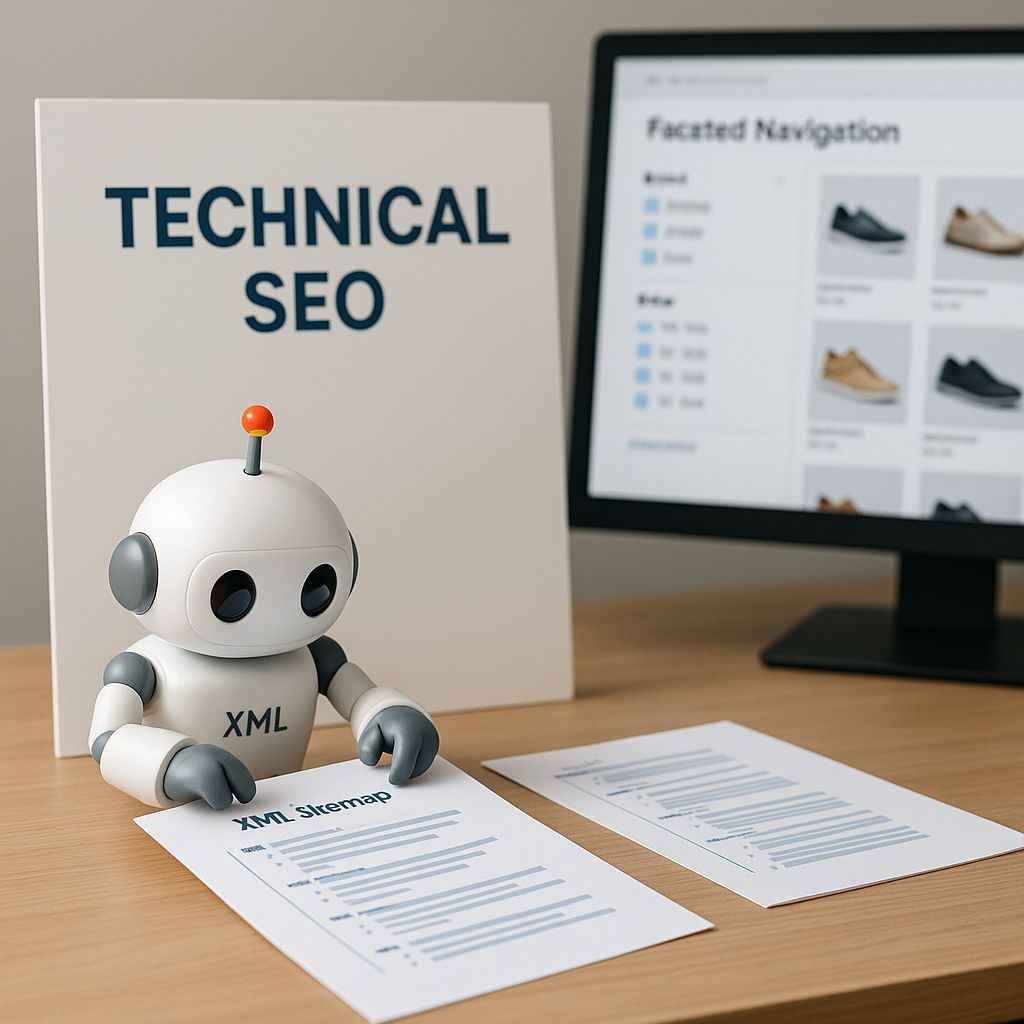
And underneath all of it, your site’s technical foundations need to be solid. Page speed, mobile performance, and the behind-the-scenes formatting that tells Google how to read your pages. If these foundations are off, even great products and great content will not get the visibility they deserve.
Each of these is a real piece of work. Done well, they transform a site that Google ignores into one that Google actively sends customers to. If you want to see what this looks like applied to your specific store, here is how we approach ecommerce SEO for Nashville businesses.
Frequently Asked Questions
Can my small Nashville online store really compete with Amazon and Etsy on Google? Not for broad searches like “buy candles online.” But for specific searches like “soy candles Nashville” or “handmade Tennessee gifts shipped,” absolutely. Large platforms do not create content about Nashville neighborhoods, local sourcing, or the story behind your products. A small store with deep local content wins those searches because Google prioritizes relevance and specificity over size.
I sell on Etsy and it works. Do I really need my own site to show up on Google? Etsy is a good sales channel. The issue is dependency. When your only visibility comes from a platform you do not control, any change to that platform’s fees, algorithm, or policies directly affects your revenue. A website that shows up on Google gives you a channel that belongs to you, grows over time, and does not charge a commission on every sale.
How long does it take for an online store to start showing up on Google? Most stores start appearing in search results for specific product and local searches within two to three months of making structural improvements. Meaningful traffic that leads to sales usually takes four to six months. Unlike marketplace fees or ad spend, the work compounds. Pages that start ranking in month three are still bringing visitors in month twelve.
Do I need to rebuild my whole website? Usually not. Most Nashville online stores we see have a solid enough foundation. What they lack is depth: category structure, product descriptions, content that answers buyer questions, and the technical formatting that helps Google read the site correctly. Building on top of what you have is almost always more effective than starting over.
Where should I start if my site gets zero traffic from Google? Start with understanding where you stand. A search visibility audit shows which searches you are missing, which pages Google is ignoring, and where the fastest opportunities are. From there, the priorities become clear. Call Rank Nashville at (615) 988-1309 for a free ecommerce audit.
I only sell during certain seasons. Is SEO still worth it for a seasonal business? Yes, and seasonal businesses may benefit more than year-round ones. The key is having content live and ranking before the season starts. A Nashville gift shop that publishes a holiday gift guide in August is already showing up in search results by October when buyers start looking. A bachelorette supply shop that builds content in winter captures the spring search surge when planning season begins. SEO rewards preparation, and seasonal businesses that plan ahead capture demand that competitors scramble for when the season is already underway.
Your Customers Are Searching. The Question Is Who They Find.
Every day, someone who visited Nashville last month searches for a product you sell. Every bachelorette party organizer looks for Nashville-themed gifts online. Every holiday shopper searches for something handmade, something local, something with a story. Right now, a marketplace or a competitor answers those searches.
Your website can answer them instead. It starts with understanding why Google is not showing your store and making the structural changes that fix it.
Call Nick Rizkalla at (615) 988-1309 for a free ecommerce audit. We will show you exactly which Nashville searches your store is missing and what it takes to start showing up.
Rank Nashville 615 Main St. Suite 123, Nashville, TN 37206 (615) 988-1309
Written by Nick Rizkalla, Nashville SEO Lead at Rank Nashville. Over 14 years of experience in search strategy across legal, medical, e-commerce, and service industry businesses. Based in West Nashville.